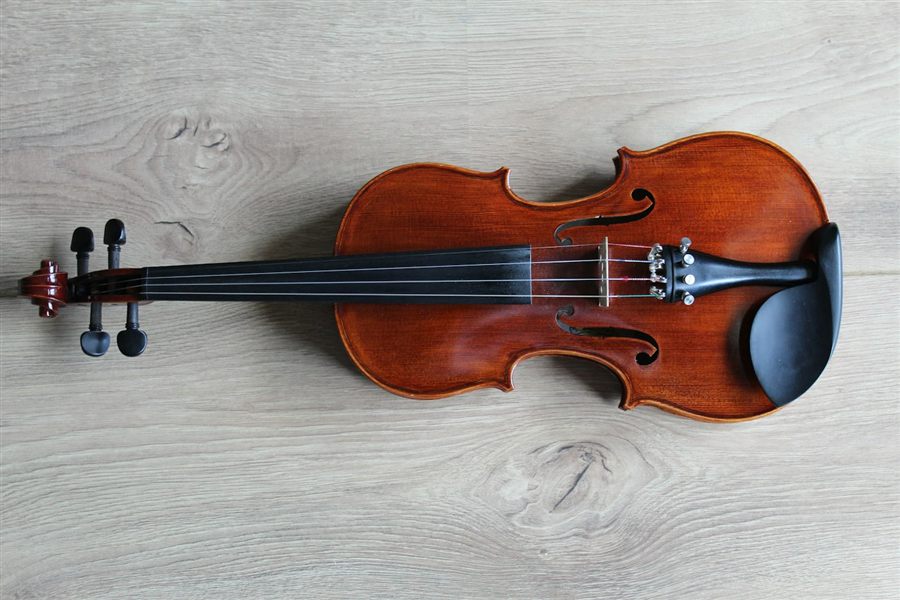
Short answer: For a first set, steel-core strings or a balanced synthetic-core set are the sensible choice: they settle quickly and cope well with changes in temperature and humidity. Gut strings sound the most complex but need patience when tuning. Always change one string at a time so the bridge stays upright and the soundpost stays in place.
The three string types at a glance
What matters is the core of the string, the material under the winding. It shapes tone color, response, tuning stability and price. The differences are real but smaller than marketing copy suggests: the violin itself, its bridge and your bowing all shape the sound just as much. A fresh set of strings changes a violin's character more than almost any other adjustment you can undo at any time.
| Trait | Gut core | Synthetic core | Steel core |
|---|---|---|---|
| Tone | warm, soft, rich in overtones, wide range of color | from warm to brilliant depending on the model, usually more focused than gut | clear, direct, bright; often heard as thin, though some models sound softer |
| Response | somewhat slower, asks for bow finesse | fast to medium | very fast |
| Tuning stability | low, reacts to temperature and humidity | high | very high, settles almost at once |
| Break-in | several days up to about a week | usually 1 to 2 days, some models 3 to 5 days | hardly any |
| Tension | lowest | medium to high, depending on the model | highest |
| Price | highest | medium to high | lowest |
Steel core
Steel strings are sturdy, inexpensive and hold pitch extremely well. They respond very quickly and sound clear and focused. The trade-off is a tone many players find thinner or sharper. There are also rope-core steel sets that sound noticeably softer and fuller. Steel is common in teaching because students do not have to retune constantly.
Synthetic core
Synthetic strings (typically nylon or polyester with a metal winding) have existed for about 40 years. They try to combine the warmth of gut with the stability of steel and are now the standard choice for advancing players and many professionals. The range is wide: some models are deliberately brilliant, others dark and soft. They are barely sensitive to temperature and humidity and are mostly settled after one or two days. If you do not know what suits your violin, a balanced mid-priced synthetic set is usually the safest bet.
Gut core
Gut strings are traditionally made from sheep intestine and are mostly metal-wound today. They offer the most complex, warmest tone but demand more attention: they drift with climate changes, need retuning for several days after installation and last anywhere from a few months to about a year depending on how much you play. The thin gut E string in particular breaks easily, which is why a plain steel E became standard even on gut-strung instruments. Gut is rarely recommended as a beginner's first set.
Tension: why it matters
Every string pulls on the bridge with a certain force. As a rough guide, the E string sits at about 7 to 8.5 kg depending on the model, the A at about 5 to 6 kg and the D at about 4 to 5 kg; figures vary by gauge and by who measured. Gut sets have the lowest overall tension, steel and some synthetic sets the highest. Higher tension usually brings more power and quicker response but can sound sharper or more pressed on some instruments. Lower tension feels softer under the fingers and often lets the violin ring more openly. How bridge and soundpost work with the string load is covered in checking bridge position and soundpost.
Treating the E string separately
The E string is the most frequently swapped single string because it shapes the sound of the upper register so strongly. A plain steel E is the usual choice and sounds bright and direct. There are also plated versions (gold, platinum, tin) and wound versions. Gold-plated strings tend to wear out faster. Some violins whistle on the E; switching to a wound or different model often cures it. Steel strings change pitch with the tiniest peg movement, so tuning accurately with the peg alone is hard. A fine tuner on the E is therefore practically standard, and beginners are well served by fine tuners on all four strings.
Mixing strings
Mixed sets are common and not a defect. The most usual case is a steel E with synthetic A, D and G. When mixing brands, tensions should be compatible, otherwise one string sounds louder or sharper than its neighbors. Matched complete sets are the safe route; swapping single strings works best when you want to solve a specific tonal or playing problem. Expensive strings are no substitute for diagnosis: if a dull sound comes from the instrument itself, even the priciest set will not fix it.
How often to change strings
There is no fixed calendar. Figures range from about two to three months for very heavy playing to a year for casual playing. Commonly quoted rules of thumb are about six months for regular practice, roughly nine months at around ten hours a week and a year at half an hour a day. High strings (E, A) wear faster than low ones and are cheaper to replace. Instead of the calendar, watch for these signs:
- The tone turns dull and tired, response gets sluggish.
- The string sounds "false": pitch feels unreliable and fifths will not tune cleanly.
- The winding unravels or frays, corrosion or discoloration shows.
- The strings behave unevenly, one sounding clearly worse than its neighbors.
If a used violin comes with visibly old strings, budget for a fresh set right away; old strings make almost any instrument sound dull. For the overall budget see budget tiers when buying used, and for checking a violin before buying see buying a used violin: what to look for.
Changing strings step by step
The basic principle: remove and replace only one string at a time. The bridge is not glued; it is held only by string tension, and the soundpost inside the body can fall over once the tension is gone. You need the new set, a soft pencil (graphite) and a bit of calm.
- Prepare: Hold the violin securely on your lap or a soft surface so you can see the pegbox and tailpiece. A commonly mentioned order is G, E, D, A; what matters is replacing one string after another.
- Loosen the old string: Turn the peg until the string is slack, then unhook the ball or loop from the fine tuner or tailpiece.
- Apply graphite: While the other three strings are under tension, rub the soft pencil into the nut groove and the bridge groove. The thin graphite layer acts as a lubricant: the string catches less and tunes more smoothly.
- Insert the new string: Hook the ball end into the fine tuner or tailpiece, then pass the other end through the hole in the peg (leave about half a centimeter sticking out).
- Wind it on: Wind neatly side by side toward the outer wall of the pegbox without letting it touch the wall. Press the peg gently inward as you turn so it seats firmly.
- Bring it to pitch: Tighten in small steps, not in jerks. On the E string a small protective tube often sits over the bridge to stop the string cutting into it.
- Check the bridge: Check halfway and at the end that the bridge stands upright. A slight shift can be corrected carefully with your thumbs; if in doubt, take it to a shop.
- Retune: New strings stretch at first and drift often. Retune several times over the first few days.
Keeping the bridge straight
The bridge should stand perpendicular to the top; the back face (toward the tailpiece) forms a right angle with it. It often leans slightly toward the fingerboard as strings are tightened. To correct it, loosen the strings slightly (keeping some tension), gently tilt the bridge back toward the tailpiece and tighten again. String tension usually settles it into place. If the bridge wobbles, leans badly or the soundpost seems loose, that is a job for a repair shop.
Common mistakes
- Removing all four strings at once: the bridge falls, the soundpost can tip, and it then has to be reset in a shop.
- Forgetting graphite: the string binds in the groove, jumps in pitch or pings.
- Tightening new strings too fast or tuning too high: thin strings in particular break.
- Judging a set after one day: synthetic and gut often sound slightly raspy at first and need time to settle.
- Wrong size: smaller violins have their own sets, see violin sizes for children.
- Buying expensive strings without knowing what the instrument needs.
- Ignoring sticking or slipping pegs: that is a job for a luthier.
What strings cost
Examples for full-size 4/4 sets in the US (as of Oct. 2026), depending on retailer and E-string variant:
| Set type | Example model | Typical price |
|---|---|---|
| Steel, basic | Prim | about $30 to $55 |
| Steel, wound E option | Helicore | about $55 to $60 |
| Synthetic, entry to mid-range | Dominant, Tonica | about $64 to $93 |
| Synthetic, upper range | Evah Pirazzi | about $96 to $115 |
Student sets in general run roughly $47 to $86, intermediate sets $84 to $149, and professional sets from about $100 up to $270 and more. A premium E string on its own costs roughly $20 to $31 or more. A basic maintenance visit at a US shop starts around $35 (as of Oct. 2026) and typically includes an inspection and bridge and soundpost adjustment; what a string change costs varies by shop, so get a quote. Changing strings yourself saves the fee and teaches you how your instrument works.
Recommendation for beginners
- First set: a solid steel set or a balanced mid-priced synthetic set, with a fine tuner on the E.
- If the violin sounds dull: pick a brighter type. If it sounds sharp: go for a softer, lower-tension set.
- With quick climate swings (heating, car transport): prefer synthetic or steel.
- Gut only once tuning and humidity care are second nature and you really want the tonal difference.
- Always change one string at a time and check the bridge afterward.
Myths about violin strings
- "More expensive is better." Not automatically. The right string is the one with which instrument and player work well together.
- "Gut always sounds best." It sounds different, not inherently better, and does not suit every violin or style.
- "Steel is only for beginners." Advanced players use steel too, especially as an E string.
- "Mixing is a mistake." Mixed sets are common as long as the tensions fit together.
- "Strings last until they break." They sound dull and go out of tune long before that.
Care between changes
Rosin dust and a crust on the strings deaden the tone. Wipe them with a soft cloth after playing; stubborn buildup can be gently scrubbed off with a cork without harming the winding. A stable room climate protects strings, pegs and bridge alike.