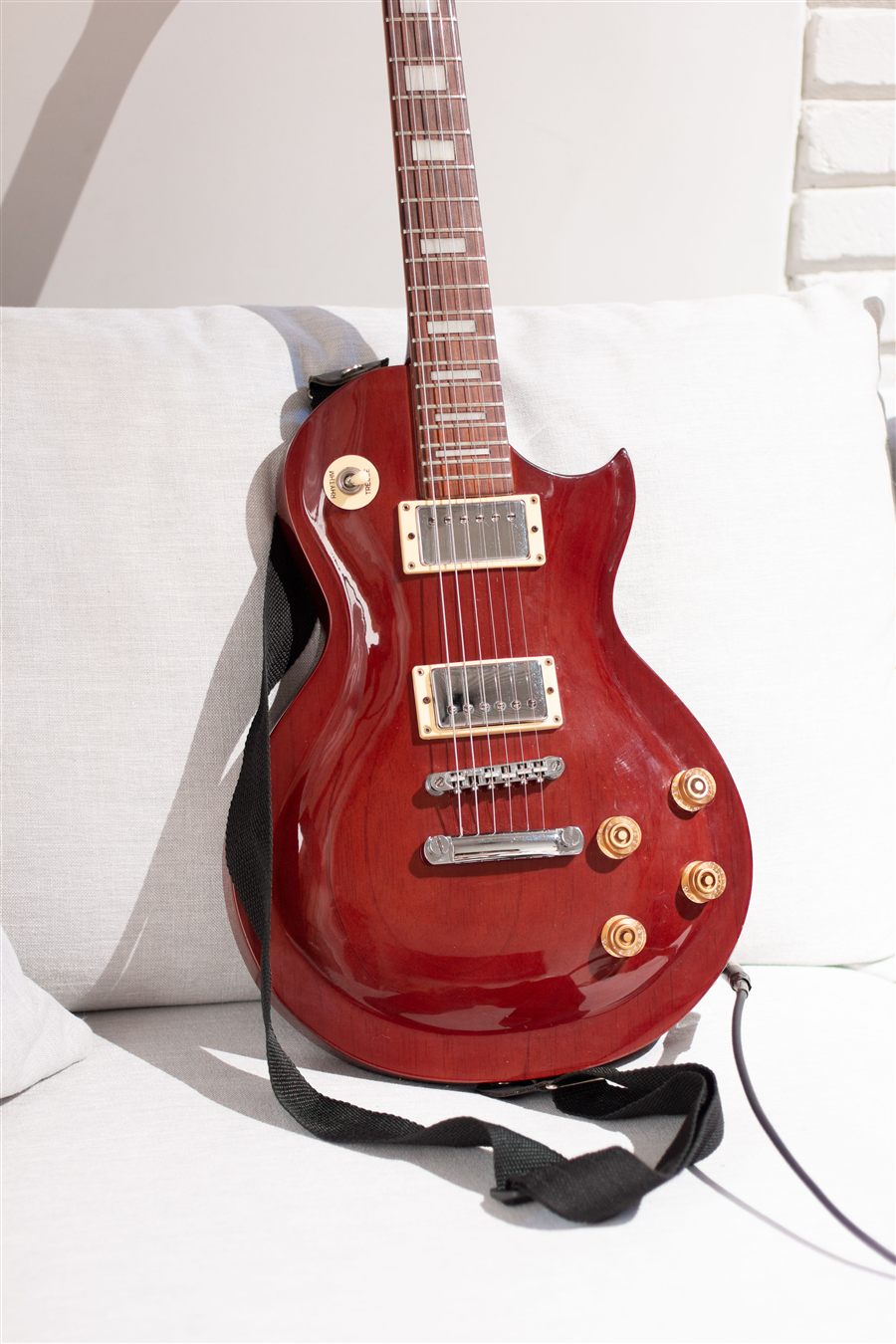
The short answer: a setup is the set of small mechanical adjustments that decide how an electric guitar plays: neck relief, string height (action), intonation, nut condition and pickup height. The order matters: relief first, then action, then intonation. You can check most of it yourself with basic tools and adjust in small steps. If the truss rod resists, if the frets are worn down, or if a job removes or replaces material, the guitar belongs with a tech.
What a Setup Includes
Two identical guitars can feel completely different depending on how they are set up. That is why a used guitar that plays badly in the shop is often not a repair case at all, just a guitar that needs a setup. A full setup usually covers:
- Fresh strings, because old strings throw off every measurement and every intonation check.
- Neck relief, adjusted with the truss rod.
- Action at the bridge, plus tremolo angle on guitars with a floating tremolo.
- Nut height and slot condition.
- Intonation at the saddles.
- Pickup height, a quick electronics check (scratchy pots, loose jack) and a cleaning.
- Fret polishing or a fret level when the frets need it.
The sequence is not arbitrary. Relief changes the action, and action changes the effective string length and therefore the intonation. If you set intonation first and move the truss rod afterwards, you start over.
Checking Neck Relief
Relief is the slight forward bow in the neck that gives vibrating strings room to move. A perfectly flat neck often buzzes, while a neck with too much bow raises the strings in the middle and makes the guitar feel stiff.
How to Measure
- Tune the guitar to pitch and hold it in playing position, with fresh or at least not worn-out strings.
- Fret the low E string at the first fret (a capo can replace your fretting hand) and press it down at the last fret or where the neck meets the body. The string is now your straightedge.
- Look at the gap between the underside of the string and the top of the frets around the 7th to 9th fret. A feeler gauge measures it; without one you can at least see whether there is any gap at all.
Target Values
Sources differ, but typical relief falls between roughly 0.15 and 0.3 mm (about .006 to .012 in), with 0.2 to 0.25 mm (.008 to .010 in) quoted most often (rule of thumb). Hard pickers and high-gain players tend to want a little more, light touch players can run less. The exact number matters less than the result: no buzz and a comfortable feel.
The Truss Rod: Small Steps Only
The truss rod is a steel rod inside the neck that works against string pull. Single-action rods can only straighten the neck against the bow, dual-action rods work in both directions. Depending on the build, access is at the headstock or at the heel end, and on many set-neck guitars behind a small cover plate. For how necks are built, see bolt-on, set-neck and neck-through.
How to Adjust
- Turning clockwise tightens the rod, the neck gets straighter and relief shrinks. Turning counterclockwise loosens it and relief grows.
- Turn no more than an eighth to a quarter turn at a time, retune, and let the neck settle for a few minutes before measuring again.
- If a step or two did not get you there, take a break and measure again later. The neck reacts with a delay.
When to Go to a Tech
Stop and take the guitar to a shop if the rod is hard to turn, the adjustment barely changes anything, a back bow does not correct even with the rod fully loosened, or the neck is visibly warped. Forcing it risks spinning the rod or stripping the thread. Replacing a truss rod is a major job and costs far more than a normal setup.
Action: String Height
Action is the gap between string and fret. Measure at the 12th fret from the top of the fret to the underside of the string, most easily with a ruler marked in millimeters. For electric guitars these are typical starting points:
| Setting | Action at the 12th fret |
|---|---|
| Common range (rule of thumb) | about 1.6 to 2.4 mm (1/16 to 3/32 in) |
| High E string | about 1.5 to 2.0 mm |
| Low E string | about 1.6 to 2.5 mm |
| Very low (lead playing, light touch) | from about 1.0 to 1.5 mm |
| Higher (rhythm, hard attack) | about 2.0 to 2.5 mm |
Low action is easier to fret but buzzes sooner. Higher action buzzes less but takes more effort and can make the upper register feel clumsy. Fretboard radius plays a part too: a strongly curved board (small radius) needs a bit more clearance for bends, flatter boards allow lower settings.
Depending on the bridge, you set height with small screws on the saddles (Strat style), with wheels on the posts (Les Paul style) or at the posts of a floating tremolo. Always raise or lower in small steps, retune and check that no string buzzes at any fret. On floating tremolos the height also depends on the tremolo angle, more in tremolo systems explained.
Intonation and Octave Accuracy
Fret spacing is fixed, but every string has a different thickness and mass. So the vibrating length of each string has to be set individually at the bridge to make the guitar play in tune up the neck, not just on the open strings.
Checking and Adjusting
- Put on fresh strings and tune precisely with a tuner.
- Play the harmonic at the 12th fret (just touch the string, do not press it) and note the pitch or read it off the tuner.
- Fret the same string normally at the 12th fret. Both notes should match.
- If the fretted note is sharp, the string is too short: move the saddle back, away from the nut. If it is flat, move the saddle forward.
- Retune after every change and compare again. Finally, make sure the open strings still sit in tune.
All you need is a screwdriver and a tuner. Whenever you change the action, recheck the intonation afterwards.
Pickup Height
The distance from pickups to strings affects volume, clarity and sustain. The usual method is to press the string down at the last fret and measure from the underside of the string to the top of the pole pieces, separately for the bass and treble side. The treble side usually sits a little closer than the bass side. Published values vary a lot with the measuring method; these starting points (rule of thumb, measured at the last fret) are common:
- Strat-style single coils: about 2.0 mm (bass) and 1.6 mm (treble).
- Humbuckers: about 2.4 mm (bass) and 2.0 mm (treble); humbuckers are less critical.
- P90s: about 2.0 to 2.5 mm (bass) and 1.8 to 2.2 mm (treble).
- Active pickups: usually a bit farther away, around 2.5 to 3.0 mm.
A pickup set too close lets its magnet tug at the strings and disturb their vibration: the tone gets wobbly, sustain shortens and intonation suffers. Set too far away, the guitar sounds thin and quiet. Change one side by a quarter turn of the screws at a time and listen on a clean sound. For how the pickup types sound, see single coil vs. humbucker.
String Gauges: 9s, 10s and 11s
String gauge is measured in thousandths of an inch and usually names the thinnest string. The common sets:
| Set | Gauges | Character |
|---|---|---|
| 9s (Extra Light) | .009 / .011 / .016 / .024 / .032 / .042 | Easy to fret and bend, popular for lead and beginners, can sound thinner |
| 10s (Regular Light) | .010 / .013 / .017 / .026 / .036 / .046 | The default for many players, a balance of feel and punch |
| 11s (Medium) | .011 / .014 / .018 / .028 / .038 / .048 | Fuller and steadier, needs more finger strength |
Scale Length and Feel
How a set feels depends heavily on scale length, the freely vibrating string length. The shorter the scale, the softer the same set feels. The same string at the same pitch is calculated to be around 6 percent tighter on a long 25.5 in scale than on a short 24.75 in one. That is why many players on shorter-scale guitars pick a slightly heavier set than they would on a long scale.
Tuning and Setup Consequences
- Lower tunings call for heavier strings to keep tension up: roughly one size heavier for a half step down, often just a heavier low E for drop D, and 11s or 12s for two half steps down.
- Going up one gauge changes total tension noticeably (roughly 15 percent from 10s to 11s). Relief changes with it: heavier strings pull the neck forward more, lighter strings let it straighten. Check relief, action and intonation after the switch.
- Heavier strings may not sit properly in the nut slots. If they bind and the guitar goes out of tune, the nut needs work (shop job).
- On floating tremolos a different set changes the balance angle, so the tremolo has to be reset.
- Thin strings get pushed out of tune more easily when fretting. Players with a firm grip often get cleaner results from slightly heavier strings.
When trying a used guitar, ask what gauge is on it. An unusually light or heavy set does not show how the guitar plays with a common set, and some guitars were set up for a specific gauge.
Changing Strings
Change strings one at a time so the neck never fully relaxes, or all at once if you want to clean the fretboard and hardware too. Wind two to three turns on the post, stretch the strings gently and retune several times until they hold pitch. How often you change depends on how you play: with heavy playing, wear and tone loss show after one to two weeks, and after about three months or roughly 100 hours most sets are clearly worn out (rule of thumb). Sweat, acidic hands and corrosion shorten string life.
Fret Wear
Frets wear from playing and bending, most in the first frets up to about the ninth and usually under the thin strings. Some wear on a used guitar is normal.
Signs
- Visible flat spots or grooves under the strings that you can feel with a fingernail.
- Buzzing at certain frets only rather than across the neck. That points to uneven fret height more than to a truss rod or action problem.
- Dead notes, choked bends or a "zing" at specific spots.
- On heavily played guitars wear can show up within one to two years, sooner with soft fret wire.
Level and Crown vs. Refret
In a fret level (leveling, recrowning and polishing) the tech files all frets to one plane and rounds them again. It removes material but is a routine service that can be done several times on one guitar. In a refret all the fret wire is replaced. That becomes necessary when the frets would be too low after leveling. For most players the lower limit is about 0.65 mm (.025 in) of fret height (rule of thumb); new smaller frets start at roughly 0.8 to 0.9 mm. After a refret the nut often needs adjusting. Both jobs need special tools and belong in a shop. A bound fretboard makes a refret more expensive.
If wear is clearly visible, especially on older or heavily played guitars, budget for a possible refret when buying used, see also buying a used electric guitar.
How Often a Setup Is Needed
As a rule of thumb, get a setup every six to twelve months, more often if you play a lot. Wood moves with temperature and humidity, so a setup often shifts with the seasons. A string change alone does not always cover it. After buying a used guitar a check is worthwhile because you do not know when or how it was last set up.
Shop Costs (United States, USD)
These are guideline figures from published shop price lists (as of Oct. 2026); actual prices depend on the shop and the guitar's condition:
| Service | Guideline |
|---|---|
| Standard electric setup | about 100 to 150 USD (as of Oct. 2026); more thorough setups at some shops about 275 USD |
| Setup with Floyd Rose, locking tremolo or 12 strings | about 120 to 175 USD, at some shops up to 300 USD |
| Restring and tune | from about 25 USD, at some shops 50 to 65 USD |
| Restring with action and intonation adjustment | about 70 to 90 USD |
| Intonation adjustment only | about 30 to 40 USD |
| Fret level, crown and polish | about 225 USD, around 300 USD with setup |
| Full refret | about 425 to 650 USD; stainless steel wire adds roughly 100 USD; bound fretboards cost more |
| New nut | about 150 USD |
| Truss rod replacement | from about 750 USD |
Broader overviews quote about 40 to 150 USD for a basic setup and a wide range of roughly 350 to 1,200 USD for a refret, depending on region and wire. Waiting times at good shops can run several weeks. For anything involving the neck or fretboard, get a quote.
Common Mistakes
- Wrong order: setting intonation first, then the truss rod. Every relief change throws the intonation off again.
- Truss rod turns that are too big, or forcing against resistance.
- Measuring with old strings or with the guitar out of tune.
- Action too low, until notes choke, just because low feels good.
- Changing gauge without readjusting. After a different set, relief, action and intonation rarely still fit.
- Pickups set too close, so the tone wobbles and sustain suffers.
- Blaming the whole instrument. Buzz at a few frets is often a fret issue, not a neck issue.
- Repairing the electronics without knowledge: soldering and rewiring belong in a shop.
More buying pitfalls are covered in common mistakes when buying a first electric guitar.