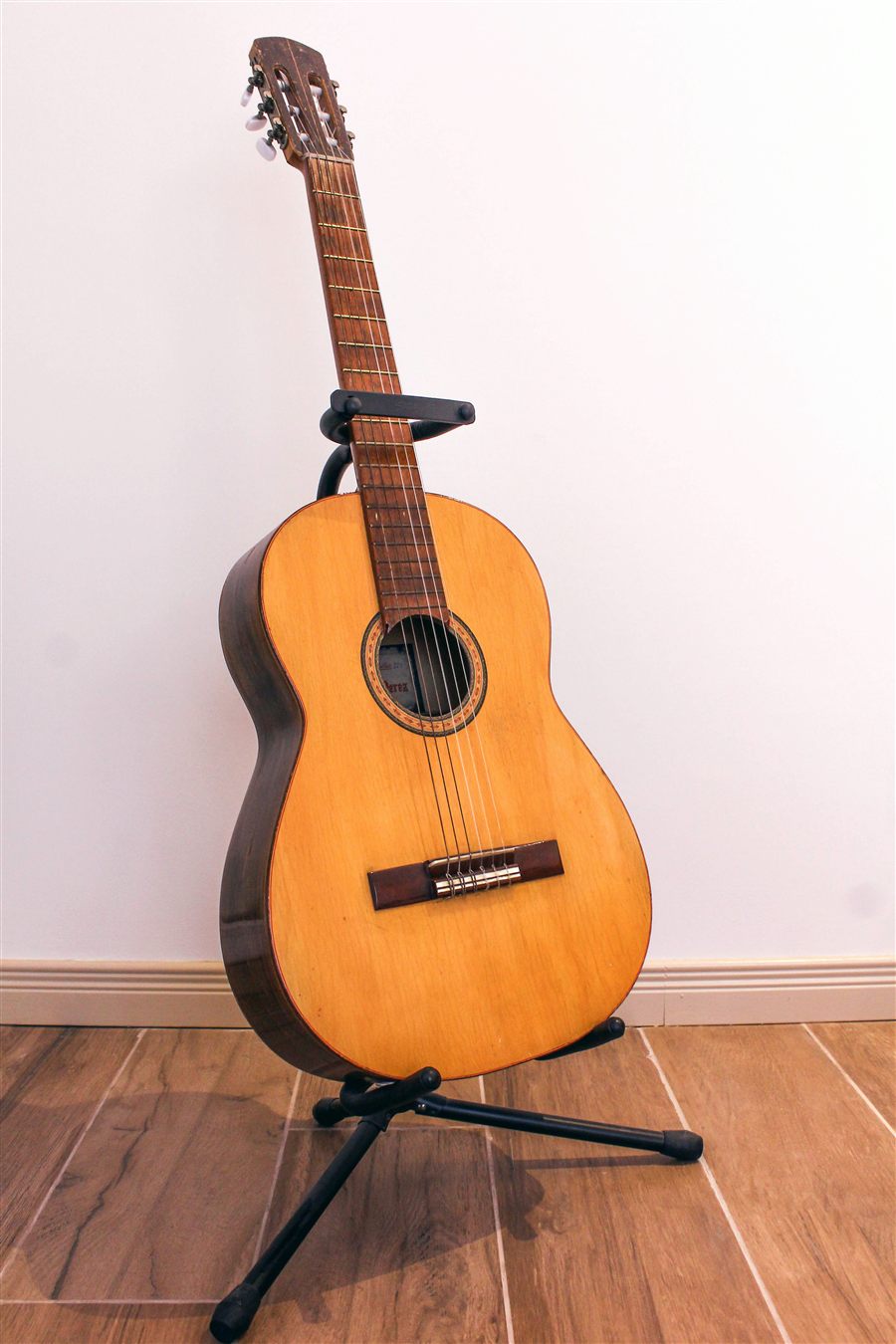
A used classical guitar is one of the smartest ways to get a good instrument, because the steepest depreciation has already happened. What decides the deal is the condition of the top, bridge and neck, since that is where the expensive problems live. If you inspect in a fixed order, read the climate history and add realistic repair costs to the asking price, you can tell within minutes whether an offer is worth it or whether to keep looking.
Prices and depreciation
How much value does a classical guitar lose?
It depends heavily on brand and tier. Budget nylon-string guitars often sell for half or less of their new price, while solid-top and handmade instruments hold their value far better, and some mid- to high-tier models retain roughly 72 to 80 percent of the retail price over three to five years (Oct. 2026). Treat these as rules of thumb: the brand, age, whether the top is solid or laminated (see solid wood vs. plywood), condition and included case all move the price noticeably.
Used price tiers in the US
New classical guitars start at roughly $300 to $700 for entry level, the standard class sits around $300 to $1,000, and luthier-built instruments begin around $3,000 (Oct. 2026). On the used market, a recent price survey for one popular brand shows how the tiers look in practice:
| Used tier | Typical used range (Oct. 2026) |
|---|---|
| Entry level and mini sizes | about $180 to $320 |
| Solid-top mid-range models | about $280 to $580 |
| Professional-grade factory models | about $1,150 to $1,450, up to roughly $1,950 for top models in mint condition with a hard case |
| Overall spread for that brand | about $200 to $2,500, average around $620 |
These ranges come from one brand's market and are only a guide; compare current listings of the exact model, and see factory vs. handmade guitars for what a higher price should buy you.
Where to buy and how to try it
- Music stores and luthiers: highest prices, but you get advice, a checked instrument and usually a return window.
- Online marketplaces and classifieds: often cheaper, but unchecked. Inspect in person if you can, bring an experienced player, and get the condition described in writing.
- Buying by mail: only with plenty of photos of the top, bridge, neck, fingerboard and headstock, clear answers about repairs and storage, and a return option. If photos of an area are missing, ask for them or walk away. When it arrives, play it for a few hours and check everything, but do not adjust or modify anything, or a return becomes difficult.
- Trying it out: play every string through all positions, pay special attention to the treble strings, and listen for buzzes or dead spots. Fresh strings give a fairer picture than old, dull ones. If you doubt a flaw, get a rough repair quote from a local shop before you buy.
The order of inspection
Always go in the same order so nothing slips through: first the overall look in raking light (bulges, cracks), then bridge and top, then neck and frets, then the inside and the tap test, and finally playability, string height and intonation. Ask the seller not to clean or change the guitar beforehand. Ask why it is for sale, where it was stored and what repairs were done. The answers often tell you more than the finish does.
Checking the top
The top is the thinnest, most vibrating part of the guitar and carries all the string tension. Nylon strings pull with roughly 100 to 110 pounds in total, steel strings with about 170 to 180 (rule of thumb), and a classical guitar is built for the lower load.
- Bulge behind the bridge: run your hand flat over the top between bridge and tail. A noticeable hump shows that string tension has pulled the top upward (often called belly or bellying). A small, even rise is common; a clear hump can make setup hard or impossible.
- Sinking in front of the bridge and around the soundhole: sight across the top at a low angle. A dished, sunken top is a typical symptom of dry storage.
- Cracks: look over the whole top in raking light, especially around the bridge, the centre seam and the soundhole edge (more under crack types below).
- Rosette: the inlay around the soundhole should sit flush with no loose or chipped pieces. Cracks running through the rosette hint at tension in the top.
- Bracing from inside: shine a small light through the soundhole. Clean, original fan bracing and neat glue joints suggest an untouched instrument (see fan bracing explained). Loose or later-added braces are a warning sign.
The bridge: lifting, gaps and cracks
The bridge anchors all six strings directly to the top and is under constant pull. On older or badly stored instruments it is often the first place to show wear.
How to recognise a lifting bridge
- Gap: look at the edge between bridge and top from every side, including low from the side with a light. Any dark line or opening may be a beginning separation.
- Fingernail and thin card: run a fingernail along the edge; a step or unevenness is suspicious. If a thin card or sheet of paper slides under a corner of the bridge, it has lifted. This is a visual check only: do not press or pry anything.
- Movement under tension: if the bridge rocks slightly or a corner rises with strings on, the glue joint has failed.
- Cracks in the bridge: hairline cracks running from the string holes toward the bridge ends are fairly common. Note them; a crack right through the bridge can mean a new bridge is needed.
What it means for the purchase
A lifted bridge is a routine shop repair: the bridge is reglued properly before the guitar comes back to pitch. Do not attempt this yourself, because glue, clamping and fit decide whether the top holds afterwards. Factor the cost (see the table below) into your offer. It becomes serious when a lifted bridge comes with a strongly bellied or cracked top.
Crack types: hairline or structural?
Not every crack is a write-off, but every crack in the wood deserves a careful look.
- Finish checking: a fine web of lines in the lacquer only, often from sudden temperature changes. It does not go into the wood, wanders across the grain and is cosmetic.
- Hairline crack in the wood: follows the grain and can just be felt with a fingernail. It may not be dramatic yet, but cracks can run, so it is best closed early by a repairer.
- Structural crack: open, with a step in height, or located at the bridge, centre seam, a brace or the top-to-side joint. It weakens the construction. You need a quote and a clear discount, or you pass.
- Open centre seam in the top or back: almost always caused by dryness or overheating.
Well-repaired small cracks are fine; open or poorly repaired ones hurt sound and value. Ask which cracks existed and when they were repaired. A repair often shows as a slight colour change or a ridge in the finish.
Neck, frets and nut
Classical necks are wider and flatter than steel-string necks, and the load on them is much lower. Most classical guitars have no steel truss rod, and warping is rare but not impossible. Some factory models have an adjustable rod; if there is one, it can often be reached through the soundhole, and should only be turned in small steps, ideally by a shop.
- Warp: sight from the nut along the edge of the fingerboard toward the body. The edge should be straight; a bow or kink is a defect. You can also press a string at the first and last fret and judge the gap in the middle.
- Twist: sight from the headstock to see whether the fingerboard is twisted along its length (one side higher). A twisted neck is a deal-breaker.
- Correction: if the relief is wrong, repairers on classical guitars usually pull the frets and plane the board. That is shop work.
- Neck joint: check for a gap between neck and body or cracked finish at the joint.
- Frets: frets are wear parts. Light wear is normal and negotiable; deep grooves, buzzing, or sharp fret ends sticking out at the board edge belong in the calculation. Sharp ends often mean a dry fingerboard.
- Nut: strings should sit cleanly in their slots, not pinch and not buzz. A nut is comparatively cheap to replace.
Back and sides
Check the back and sides in raking light for cracks and for gaps along the glue seams and binding. Tap lightly with a knuckle across the top and back: a clear, even note is a good sign, a dull spot suggests a loose glue joint or brace. Shake the guitar gently and listen for rattling; buzzing inside usually means loose bracing. Both can be reglued, but it is shop work, and a rattle can also be a loose label or a foreign object.
Finish, tuning machines and fingerboard
- Finish: small scratches and dings do not affect the sound and are good negotiating points. Large flaking areas or deep cracks into the wood show the instrument was not treated well. A refinish is expensive and lowers the value.
- Tuning machines: turn each one in both directions: they must run smoothly, hold their pitch and not slip. If the guitar cannot be tuned cleanly, a purchase makes little sense.
- Fingerboard: check for cracks, chipped ends at the frets and dryness. Quality fingerboards are ebony or rosewood.
String height and intonation at the 12th fret
A common target is roughly 3 to 3.5 mm at the 12th fret on the high E string and 3.5 to 4 mm on the low E (Oct. 2026). Higher is tiring, lower can buzz. What matters is whether the height can be corrected: the saddle needs enough material to be sanded down. If it is already at its lowest and the strings still sit high, the neck angle is off; that is an expensive repair and, if in doubt, a deal-breaker. For intonation, compare the fretted note at the 12th fret with the harmonic at the same spot. A big difference can mean a wrongly placed saddle, uneven frets or old strings. If possible, test with fresh strings. The scale length should also suit you (see scale length and neck width).
Climate damage
Solid woods react to dryness and humidity. Typical signs of storage that was too dry: a sunken top, sharp fret ends at the board edge, open seams and cracks. Too much moisture shows as swollen sides, a wavy top or stained glue lines. As a rule of thumb, relative humidity of 45 to 55 percent is safe; manufacturer guidance spans about 40 to 65 percent, and below 30 percent the risk of cracking rises sharply. Ask how the guitar was kept: in a case with a humidifier, or on a wall next to a radiator? The case itself tells you a lot. If the guitar comes from a dry environment, inspect it closely even if it looks well kept.
Typical defects and rough repair costs
All the work below is shop work. The prices are rough guides for the US (Oct. 2026); they vary by shop and by the exact problem, so get a quote.
| Defect / job | Rough price in the US |
|---|---|
| Restring and setup adjustment | about $60 to $200 depending on shop |
| Bridge reglue (classical) | about $150 to $350 |
| Simple top crack | about $100 to $250 |
| Complex crack (across braces, through the bridge plate) | about $250 to $400 |
| New nut or saddle | about $60 to $130 |
| Full refret | about $300 to $600 |
| Neck reset, refinish | varies by shop, get a quote |
What counts is the total: a bargain with several defects often costs more than a clean instrument at a fair price. Add the purchase price and the work needed.
Negotiating
- Document defects with photos and have existing damage confirmed in writing: it protects you in a return dispute and supports a lower price.
- Negotiable: light fret wear, scratches, finish damage, an overdue setup and a missing case. Not negotiable: structural defects that permanently lower the value.
- Subtract repairs at the shop prices above and offer accordingly.
- Ask why they are selling and see whether the answers are consistent.
Red flags and deal-breakers
- A twisted or heavily warped neck
- A loose joint between neck and body
- A strongly bellied or deformed top, especially with a lifted bridge
- Open cracks at the bridge, centre seam or a brace, or several cracks together with warping
- High string action with a saddle already sanded down (neck angle)
- Signs of steel strings, or a top that had to carry them: classical guitars are not built for that (see nylon vs. steel strings)
- The seller refuses photos, test playing, returns or a written description of defects
- The label and the seller's claims do not match
A lifted bridge alone is not a deal-breaker if everything else is sound: it can be repaired and belongs in the price.
Case, accessories, label and serial number
A good hard case is a plus on a used guitar and protects against climate swings; a gig bag only protects against scratches. Footstools and spare strings are often part of the deal, so check what is included. Look through the soundhole at the label: factory instruments usually list model and serial number, handmade ones the maker's name, year and number. Compare this with the guitar (construction, woods, period). For expensive instruments by well-known makers, buy only with proof of authenticity or from a dealer who knows the maker and stands behind the instrument.
Costs after the purchase
Plan follow-up costs: new strings and a check in a shop including setup, typically in the range given above (Oct. 2026), plus fret work, nut or bridge work depending on what turns up. Do not change anything until you are sure you are keeping the guitar. Tune it gently to normal pitch and watch for a few days whether bridge and top stay stable. Keep it in its case in a room with 45 to 55 percent humidity.
Common mistakes and myths
- Old means bad: not so. On older instruments the wood has settled and the risk of new cracking is often lower.
- One crack means a write-off: no. Location, type and quality of repair decide.
- No truss rod is a defect: no. Most classical guitars get by without a steel rod because the string load is low.
- Old strings mislead: dull strings make any guitar sound worse and distort intonation.
- Judging by sound alone: a lovely tone on a warped neck or loose bridge gets expensive.
- Repairing it yourself: lifting or regluing a bridge and repairing cracks interfere with the structure and belong in a shop.
Inspection checklist
- Overall look in raking light; ask about storage and repairs.
- Top: bulge behind the bridge, sinking, cracks, rosette.
- Bridge: gap, card or paper as a visual check only, rocking, cracks in the bridge.
- Neck: sight it, check for twist, neck joint, frets, nut.
- Back and sides: cracks, tap test, rattles.
- Finish, tuning machines in both directions, fingerboard.
- String height at the 12th fret, saddle reserve, intonation.
- Check label and serial number, clarify accessories.
- Price in repairs, record defects in writing, get a quote if in doubt.