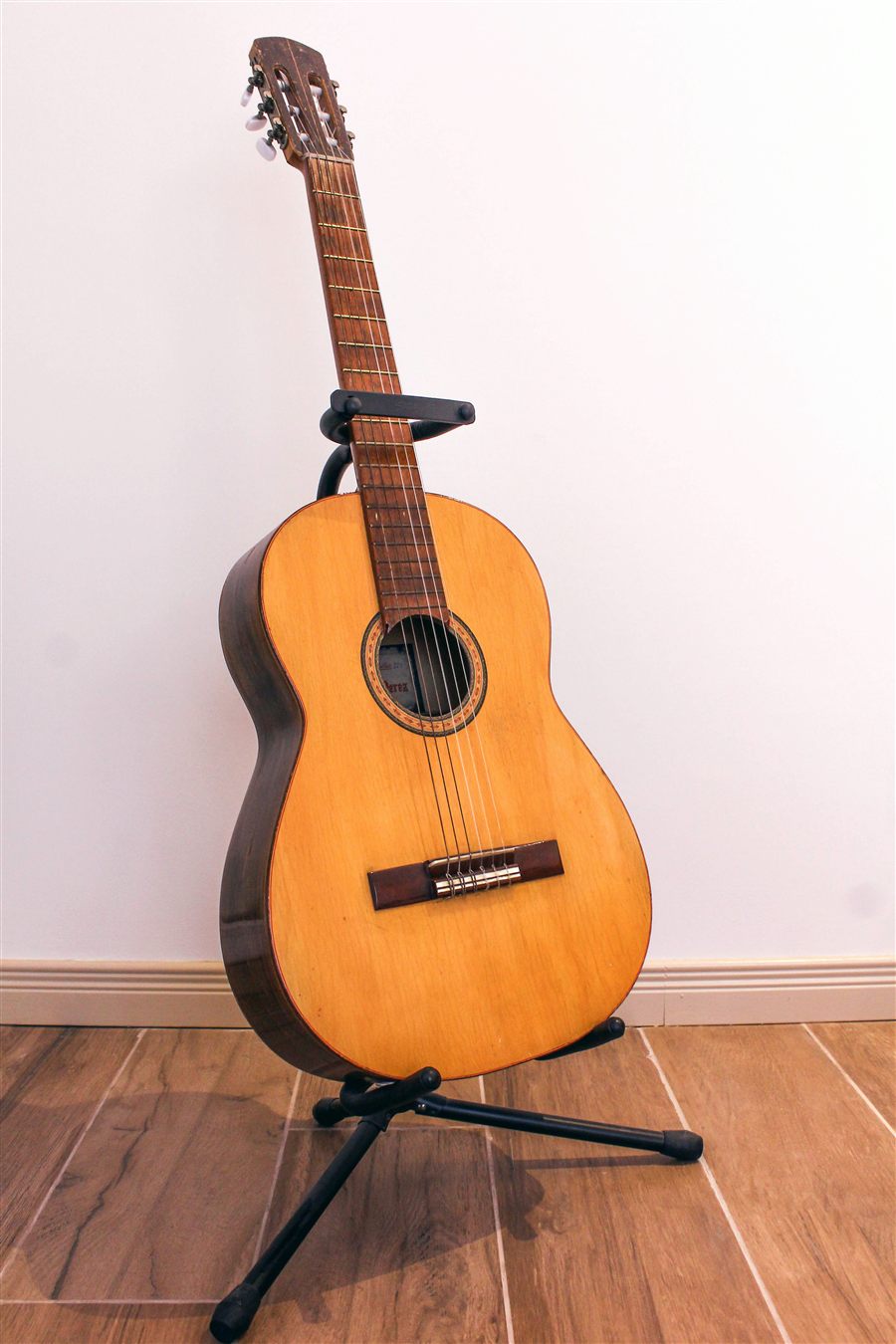
A classical guitar takes nylon strings only (with wound bass strings). A steel set pulls roughly twice as hard as a nylon set and can damage the bridge, top and neck of a classical guitar, sometimes while you are still tuning up. Which nylon set suits you comes down to material (nylon or carbon), bass winding and tension class (low, normal, high), and you will replace the set about every one to six months depending on how much you play.
Why a classical guitar needs nylon strings
The load: about twice as much
All the strings of a classical guitar together pull with roughly 80 lb (36 kg) on bridge and neck, while a standard steel-string set pulls around 160 to 180 lb (72 kg and more). The guitar is built for the lower figure: the top is braced more lightly, the bracing pattern is designed around less load, and the neck usually has no truss rod. Even where a rod is present, it is not enough to absorb the extra force. For more on the bracing, see fan bracing in the classical guitar explained.
What steel strings do to a classical guitar
- Bridge: it can lift or tear off, sometimes taking a layer of top wood with it.
- Top: it bulges between bridge and soundhole. The belly can become permanent and changes tone and action.
- Neck: it bows forward, action climbs, and in the worst case the neck fails.
- Nut and action: a classical nut has wider slots for the thicker nylon strings, and action is typically 3 to 4 mm compared with about 2.5 mm on a steel-string. Steel strings seat badly and feel uncomfortable.
- Bridge design: most classical guitars tie the strings off at the bridge rather than using pegs for ball ends, so steel strings do not fit cleanly.
The damage is expensive because top and neck repairs are among the more involved jobs. Cost depends on the extent: varies by shop, get a quote. On the used market, a classical guitar strung with steel is a warning sign. Check the bridge (any gap to the top), top bulge and neck bow with extra care, see buying a used classical guitar. A quick test with steel is no safer, because the load acts immediately.
Options for steel-string players
If you are used to the feel of a steel-string but want a nylon sound, look at crossover or hybrid guitars: they take nylon strings but have a slimmer neck (on the order of 48 mm at the nut), often a slightly curved fingerboard, a cutaway and usually a pickup. They are built for nylon as well, so steel does not belong on them either. If you really want steel strings, buy a steel-string acoustic. For scale length and neck width, see scale length and neck width for beginners.
String materials at a glance
Trebles: nylon, carbon and blends
The three high strings (e, B, G) are plain plastic strings. Classic nylon sounds warm, round and forgiving and is the usual choice for beginners. Carbon (PVDF, also called fluorocarbon) is denser, so it is thinner at the same pitch and, at equal tension, brighter and clearer with more projection. It can sound harsh on a bright guitar or with a heavy attack and often feels a little firmer. In between sit composite strings and tinted variants: black nylon sounds softer, titanium-type finishes more brilliant. Historically, gut (sheep intestine) was used and is still found for period instruments.
Basses: wound with silver or bronze
The three low strings (D, A, E) have a nylon core ("nylon silk") with a metal winding. Silver-plated copper is the most common: it is durable, resists sweat and sounds warm. Bronze winding sounds brighter. Basses often fade sooner than the trebles because finger oil and dirt dull their brilliance faster.
Which combination for what
- Beginners: normal tension, nylon trebles, silver basses: cheap, forgiving, fits almost any guitar.
- Dark-sounding guitar (for example cedar): carbon or titanium add clarity, see cedar versus spruce tonal comparison.
- Bright, sharp guitar: classic nylon or black nylon rounds off the sound.
String tension: low, normal and high
Unlike steel strings, nylon strings do not come in standardized gauges in inches. Sets are sorted by tension: low/light, normal/medium and hard/high (sometimes extra high). The classes are not standardized: one maker's "hard" set can pull about as much as another maker's "normal" set. As a rule of thumb, a full set pulls between about 82 and 99 lb (37 to 45 kg). Many normal sets sit around 86 lb (39 kg), hard sets usually 4 to 11 lb above that; European sets tend to pull somewhat more than US sets. Exact figures are listed on the makers' pages.
- Low/light tension: easier to fret and kinder to the fretting hand, suits very lightly built guitars and a gentle touch. In return it is quieter, less full, and fret buzz is more likely with a low action.
- Normal/medium tension: the standard most guitars are voiced around. A good starting point, and the first choice if your hand tires.
- Hard/high tension: more volume and projection and easier pitch control (less sensitivity to vibrato), but it takes more fretting-hand strength and loads the top harder. The sound is not automatically better; more tension can pull back overtones and sound duller, especially high on the third string.
Carbon strings are denser and can pull noticeably harder than nylon in the same class (about 22.7 lb on the high e in one example against roughly 17.4 lb for nylon). Moving from nylon to carbon therefore often makes even a "normal" set feel firmer.
Used or lightly built guitars
Because tension also decides how hard the top and bracing are loaded, avoid moving an older or already lightly built guitar to a clearly higher tension without a reason. If you see a lifted bridge, a bulging top or cracks, stay with normal or low tension and have a repair shop look at the structure. Whether a guitar handles more tension well shows when you try it: does it gain volume with hard tension without the tone getting tight? That is subjective and depends on the build.
Sound and feel
Nylon is softer under the fingers, warmer and forgives mistakes. Carbon projects more, is clearer and speaks faster, but demands cleaner technique. Tension mainly shapes the feel: high tension puts up more resistance to both fretting hand and attack, low tension gives way more softly. Try sets one after another and listen for volume, bass response, treble clarity and fretting comfort. New strings often sound especially bright in the first days and then warm up a little.
Changing strings step by step
Preparation
Lay a cloth under the strings to protect the top, and have wire cutters, a tuner and optionally a string winder ready. Change strings one at a time and tune each new string against the others so that the load on bridge and top does not drop away all at once. A full change is also a good moment to clean the fingerboard and check the tuners, neck and bridge.
The bridge knot
- Loosen the old string at the tuner, unwind it and pull it out of its knot at the bridge.
- Pass the new string through the bridge hole, leaving about 1.5 inches (3 to 4 cm) of tail.
- Bring the short end back over the string and under it (a half hitch). On the three treble strings you usually do this twice, on the basses once (the D string twice). The result looks like a figure eight.
- Pull the knot tight and make sure the loop sits low at the bridge so the string angle is right. The tail ends often hold each other in place.
Winding at the tuner
- Thread the string through the tuner post hole, leaving roughly 1.5 to 2 inches (4 to 5 cm) of slack toward the neck so there is enough string to wind.
- Loop the end back over the string and under it so it locks on itself (a self-locking wrap, not a hard knot).
- Wind neatly: the wraps sit side by side and run downward toward the headstock, not on top of each other. As a rule of thumb, use 2 to 3 wraps on the trebles and 3 to 4 on the basses. Wind the high and low E strings toward the outside, the other four toward the inside.
- Trim the excess only once the string is in tune, and never while it is under full tension.
A common order is low E, G, A, B, D, high e. Avoid kinks in nylon, because they permanently upset intonation.
Stretching and tuning stability
Nylon stretches a lot in the first days: expect two to four days of frequent retuning, especially often in the first hour after stringing. It helps to gently pull each string away from the fingerboard along its length after tuning and then retune, repeating a few times. A popular trick is to tune a half step sharp in the evening and bring it back down the next day, stretching the trebles once more. Always tune in small steps. A little graphite (pencil) in the nut slots helps against squeaking and sticking when tuning.
How often to change and how to care for strings
Figures vary widely: concert players sometimes change every one to two weeks, casual players get one to three months, and the general rule of thumb is three to six months or around 100 hours of playing. Basses fade sooner, and some players change them twice as often as the trebles. Signs it is time: the sound goes dull, the basses go muddy, the strings feel sticky or rough, or intonation up the neck no longer works.
- Wipe the strings after playing with a clean, dry or slightly alcohol-dampened cloth. Sweat and finger oils shorten their life noticeably.
- Keep relative humidity around 45 to 55 percent: too dry sounds thin and scratchy, too damp sounds dull.
- Loosen the strings for air travel or a long break, then bring them back up slowly.
- A consistent tuning is easier on the strings.
What a set costs
In the US, a standard classical set from a well-known maker costs about $12 to $15 (as of Oct. 2026): a widely used normal-tension set is about $13, a composite-treble version about $15, and another popular blue-label set about $14.50 (as of Oct. 2026). Three-packs run about $33 (as of Oct. 2026), which lowers the cost per set. Prices for premium carbon sets vary by shop. If you change every three months, strings come to a low two-digit dollar amount per quarter.
Common beginner mistakes
- Fitting steel strings (see above).
- Loosening all strings at once, so the load drops away suddenly.
- Too few wraps or a poor bridge knot: the string slips and the set will not stay in tune.
- Skipping the stretch: the guitar keeps drifting out of tune and feels unreliable.
- Wrong tension: "high" is often assumed to be better but is not the best choice for every guitar or hand.
- Waiting too long to change: old strings sound dull and intonate badly, which people often blame on the guitar.
- Kinks and a wrong stringing order: they can only be fixed later with a fresh string.
If you see a lifted bridge, top bulge or a bowed neck, the guitar belongs with a repair shop; cost varies by shop, get a quote.