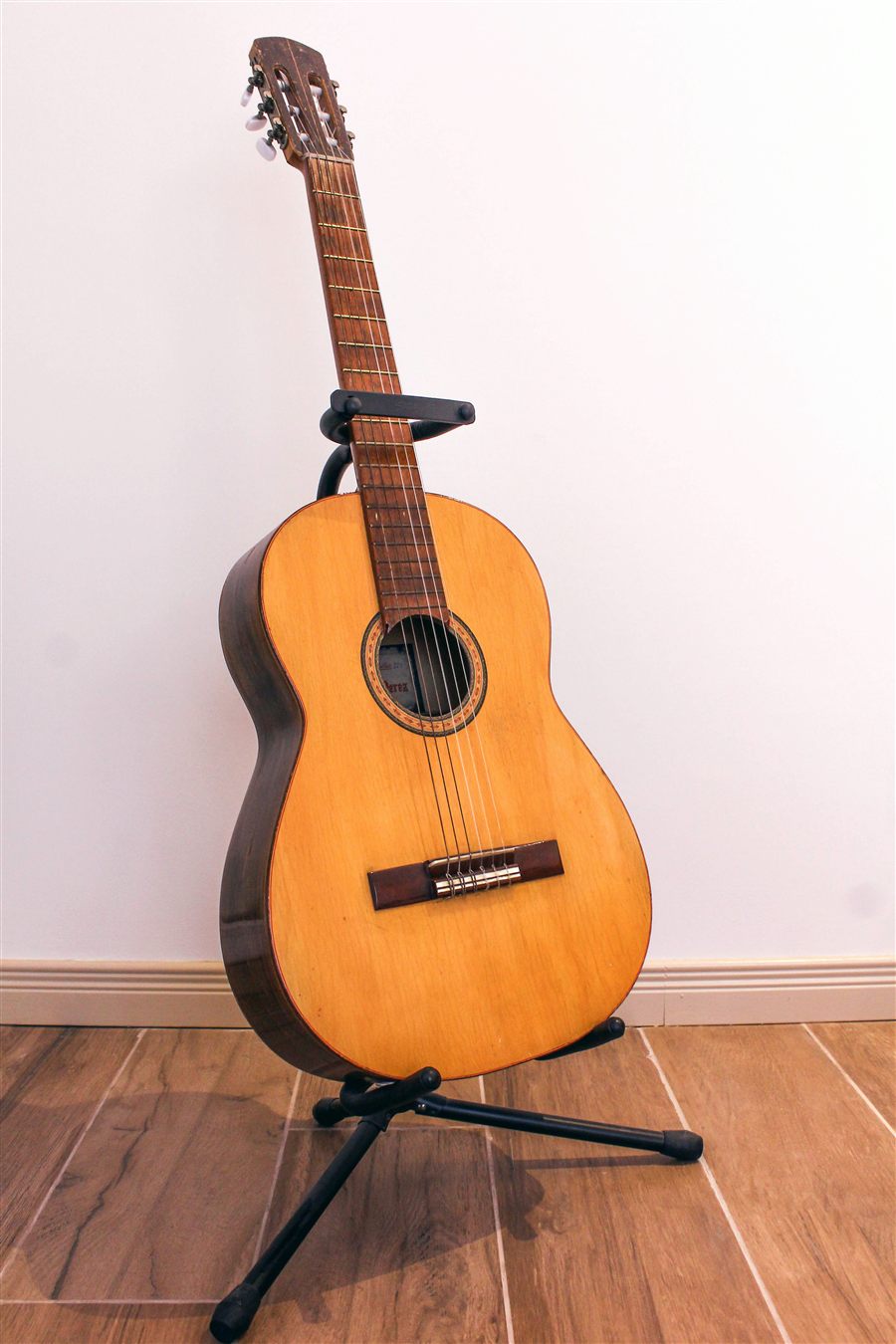
An adult classical guitar normally has a scale length of about 650 mm (25.6 in) and a nut width of 50 to 52 mm (about 2 in). Children and adults with small hands can choose shorter sizes from 7/8 down to 1/8, though the exact dimensions vary from maker to maker. A cutaway makes the upper frets easier to reach but usually costs a little tone and some extra money, and beginners rarely need one. What matters most is that neck, scale length and body fit your hands and your height.
Scale length: what it is and why it matters
Scale length is the vibrating string length between nut and bridge. It sets how far apart the frets sit and how much tension a string needs at a given pitch. Since the 19th century the classical guitar has settled at around 650 mm. Too long a scale means wider fret spacing and a bigger stretch for the fretting hand, especially in the low positions. Too short a scale puts the frets close together and can feel cramped for large hands.
For adults, one commonly cited rule of thumb matches scale length to hand span (thumb tip to little fingertip with the hand spread). Treat it as a guideline, not a standard:
- under about 170 mm (6.7 in): roughly 615 mm (a 7/8 guitar)
- 170 to 190 mm: roughly 630 mm
- 190 to 210 mm: roughly 640 mm
- 210 to 230 mm: 650 mm (standard)
- 230 to 250 mm: roughly 656 mm
- over 250 mm: roughly 664 to 665 mm (long scale)
Most adults are well served by 650 mm. Scales between 630 and 640 mm are uncommon off the shelf and often come from custom builders, and long scales near 664 mm mainly suit players with very large hands. Some experienced players also point out that the tone and build quality of the individual guitar matter more than a few millimetres of scale. Both points hold: try a shorter scale if you get pain or tension in barre chords and stretches, but do not buy one just for the number.
Guitar sizes from 1/8 to 4/4
Classical guitars come in many more sizes than steel-string guitars. The fractions are not standardised measurements but rough classes. Buying guides and spec sheets list slightly shifted scale lengths for the same size, so the table gives ranges.
| Size | Scale length (guideline) | Height | Age (rough) | Nut width |
|---|---|---|---|---|
| 4/4 | 630 to 650 mm, usually 650 mm | from about 5 ft 3 in (160 cm) | from about 13 | 50 to 52 mm, slim necks about 48 mm |
| 7/8 | about 610 to 630 mm | about 4 ft 9 in to 5 ft 3 in (145 to 160 cm) | about 10 to 14, small adults | often 48 to 50 mm |
| 3/4 | about 580 to 614 mm | about 4 ft 3 in to 5 ft 1 in (130 to 155 cm) | about 10 to 13, small hands | often about 48 mm |
| 1/2 | about 530 to 550 mm | about 3 ft 9 in to 4 ft 5 in (115 to 135 cm) | about 7 to 9 | often about 48 mm |
| 1/4 | about 470 to 490 mm | about 3 ft 7 in to 4 ft 1 in (110 to 125 cm) | about 5 to 8 | usually narrower than 48 mm |
| 1/8 | up to about 440 mm | up to about 3 ft 7 in (110 cm) | about 4 to 7 | usually narrower than 48 mm |
The ranges overlap on purpose. A child of 125 cm may sit better on a 1/4 or a 1/2 depending on arm and finger length. Height alone does not decide it; arm length, finger length and hand size matter as much. When in doubt, choose the smaller size: a child can fret cleanly on a guitar that is slightly small, but not on one that is too big.
All sizes keep 19 frets
Small guitars usually have 19 frets as well (some spec sheets say 18 to 20), so children lose no range and simply benefit from the closer fret spacing. The 12th fret divides the string into two equal halves and normally sits where the neck meets the body on classical designs.
Why 3/4 is not always 3/4
There is no common specification for neck width, body size or body depth. A 3/4 guitar from one maker can differ noticeably in scale, neck and body from the next. For example, the Yamaha CGS102A (a 1/2 size) has a 535 mm scale and a 48 mm nut, and the 3/4 version has a 580 mm scale. Always compare the real numbers (scale length, nut width, body depth) rather than the fraction.
Nut width and fingerboard: why the neck is so wide
A classical neck is clearly wider than on a steel-string acoustic (usually 43 to 45 mm, sometimes 46 mm) or an electric (about 42 mm). Classical nut widths typically run between 48 and 54 mm, and on a full-size guitar usually 50 to 52 mm. That is by design: string spacing at the nut is commonly around 43 to 44 mm from the first to the sixth string, measured centre to centre. A 52 mm nut allows spacing up to about 45 mm, while at 50 mm the outer strings get close to the edge of the fingerboard.
For beginners the wide neck has two advantages: the fingers have more room, so neighbouring strings are muted less often when fretting, and fingerstyle playing, which the instrument is built for, is cleaner. The price is a bigger stretch for the fretting hand. If your hands are small, models with a slim neck (about 48 mm) keep the scale and overall size unchanged. Very small hands may want even narrower string spacing, down to about 37 mm, but that means custom work.
Fingerboard width and neck profile
The classical fingerboard is flat (no radius like steel-string guitars) and widens toward the body. Beyond width, neck thickness counts: historic guitars often had very thin necks of about 20 to 21 mm at the first fret, whereas modern builds tend to add 1 to 2 mm. Slim necks of roughly 20 to 23 mm feel more comfortable to some players, while others miss a little more wood to hold on to for barre chords and demanding shapes. There is no rule; it depends on your hand, so playing before reading the spec sheet is best.
If you come from an electric or steel-string guitar, a classical neck feels wide and flat at first. That usually passes after a few weeks. Choosing a very slim neck only out of habit can make a later switch to standard necks harder.
Body size and shape
A full-size classical guitar is roughly 965 to 1016 mm (38 to 40 in) long overall, smaller sizes roughly 785 to 915 mm (31 to 36 in). The classical body is smaller and shallower than a steel-string body, with a slimmer waist. That makes it lighter, though also quieter and softer in the bass. For children a smaller body means the guitar rests better on the thigh and the right arm does not have to reach so far. Body depth varies by model; a 1/2 size guitar, for example, is typically 80 to 85 mm deep.
If neck and scale fit but the body feels too large, a footstool or guitar support helps. A good sitting position is part of comfort, but it does not make up for a guitar that is too big for a small child.
Cutaway: pros and cons on a classical guitar
A cutaway is a scooped-out section of the upper bout beside the neck. It gives easier access to the highest frets and makes shifting along the neck more comfortable. It is standard on electric guitars, common on steel-strings and fairly rare on classical guitars.
Shapes
There is the rounded Venetian cutaway, the pointed Florentine and the straight Maccaferri style that meets the neck at a right angle. On nylon-string guitars the rounded shape is most common.
Tone and volume
The cutaway reduces the internal air volume, and the top can no longer vibrate quite as freely. Most sources online agree the sound is somewhat limited as a result, mainly in bass and volume. How much is disputed: measurements are scarce. Beginners usually do not hear the difference; it shows more in a direct comparison or when playing alongside guitars without a cutaway. The body is also no longer symmetrical.
Structure and build
The side has to be bent into a tight curve for the cutaway, and the bracing is adapted. That takes more work, which is why guitars with a cutaway usually cost somewhat more than comparable ones without. A specific price premium is not documented and varies by model. When buying used, it is worth checking the area around the cutaway for cracks, gaps in the side joints and edge damage, because bending leaves stress there.
Access to high positions: do you need it?
Beginner classical repertoire mostly stays in the lower positions, roughly up to the 7th or 9th fret. High positions matter mainly for solo pieces, jazz or lead playing. If you already know you will play up there, a cutaway can make sense, but as a first guitar it is rarely a must. Cutaway models are also often hybrid guitars with a pickup, slimmer neck and flatter fingerboard for players coming from electric guitar. Those are different instruments with different priorities than a traditional classical guitar.
A cutaway is neither a mark of quality nor a flaw: it is a trade-off between access and tone. If pure acoustic sound matters more, take the guitar without a cutaway; if you play a lot in the high positions or plan to amplify, it is a reasonable option.
Common wrong purchases
- A guitar too big for the child: The most frequent mistake. Children grow, but on too long a scale they learn poor posture and give up sooner. When in doubt take the smaller size and move up as they grow; used children's guitars resell well.
- Comparing only the fraction: Check scale length, nut width and body depth, as 3/4 is not always 3/4.
- Hybrid or steel-string neck: A guitar with a narrow steel-string neck and nylon strings is not a classical guitar. It has different string spacing and is often too tight for classical technique.
- Bargain-basement models without testing: Very cheap big-box guitars (under about $100 (as of Oct. 2026)) often have tuning stability and fret problems. Entry-level models are also often built somewhat heavier.
- Deciding by cutaway or looks alone: Tone depends strongly on the top; a cutaway does not replace solid workmanship.
- A very slim neck on principle: It can be comfortable but does not suit every hand and can make a later switch harder.
Costs
For adult full-size guitars, beginner instruments are commonly quoted at roughly $300 to $700 (as of Oct. 2026), with factory-built mid-range guitars at about $300 to $1,000 and handmade luthier guitars from around $3,000. Children's guitars in smaller sizes vary widely by shop and season, so check current prices. For cutaway premiums and special neck widths the answer is: varies by shop and model, get a quote.
Decision guide
- Height and age: Use the table as a starting point; when in doubt take the smaller size.
- Hand span and arm length: For adults with a hand span under about 170 mm consider a 7/8 guitar or 630 to 640 mm, otherwise 650 mm.
- Nut width: 52 mm as the standard, 48 mm for very narrow hands or in small sizes.
- Cutaway: Only if you really need the high positions or want to amplify.
- Try it: Sit down, play chords in the lower positions and a barre at the 1st and 5th fret. Check that the stretch and neck profile are comfortable and no string collides with its neighbour.
- Buying used: Measure scale length and nut width, check the side around any cutaway, and do not derive dimensions from the fraction. More in the guide buying a used classical guitar.
For the top and tone, see solid vs. laminated wood and cedar vs. spruce. The differences between classical and flamenco builds are covered in flamenco vs. classical guitar.