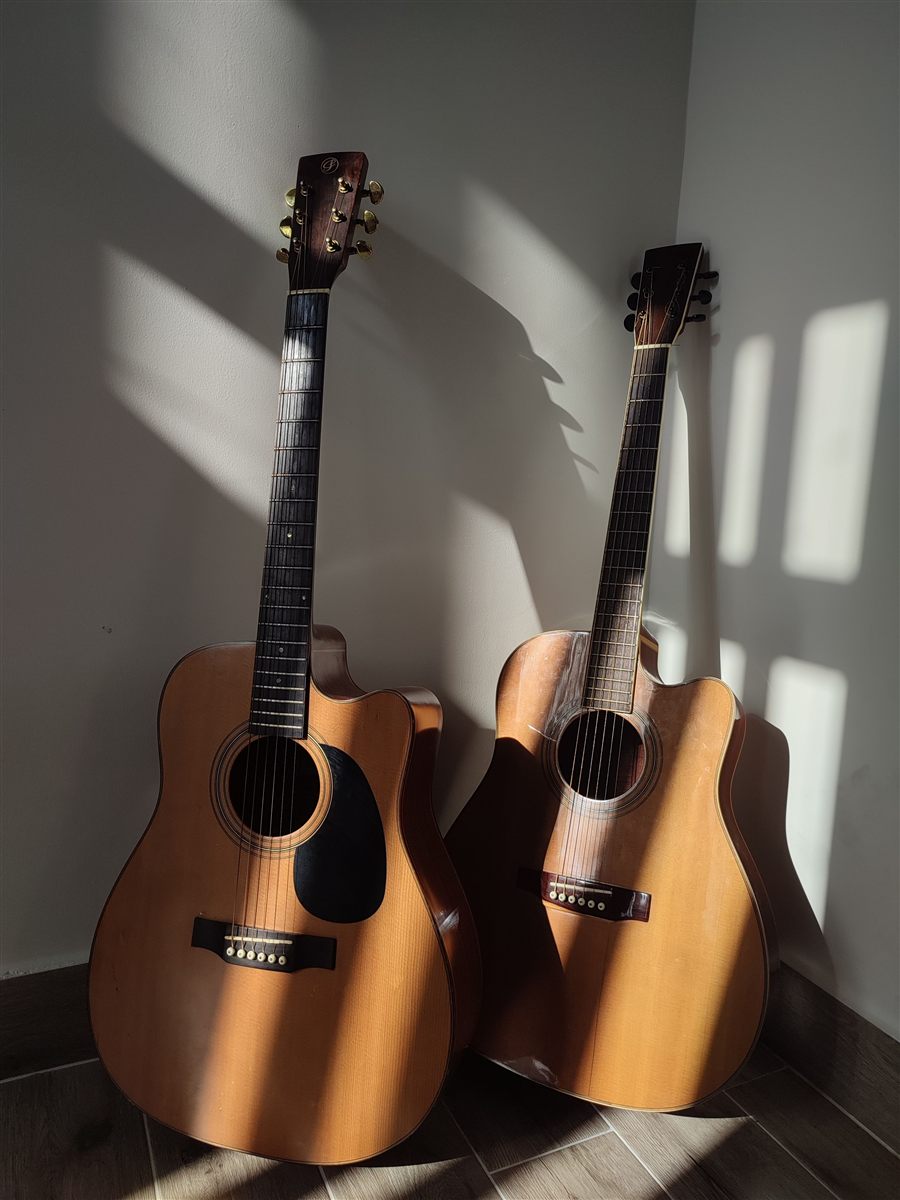
The top wood shapes a steel-string guitar's basic voice most: spruce is the versatile default, cedar is warmer and quicker to respond but compresses under hard strumming. Back and sides colour the result: rosewood adds bass depth and shimmer, mahogany sounds direct and midrange-focused. Wood is only part of the picture, though, because body shape, bracing and the individual instrument matter at least as much, and whether the wood is solid or laminate often affects durability and resale value more than the species does.
Top woods and what they do
The top (soundboard) is the part that moves most, so its stiffness and weight matter most. Physically, a light, stiff wood turns string energy into sound efficiently, which is why spruce dominates.
- Sitka spruce: the industry standard. It is generally described as balanced, with a broad dynamic range and fundamentals that are stronger than the overtones. It takes hard strumming without choking, and it can sound a little less rich when played very lightly. It sits on the large majority of steel-string guitars.
- Engelmann and Lutz spruce: Engelmann is lighter and is described as more complex with broader overtones, but with less headroom when you dig in. Lutz is described as more powerful and richer than Sitka, aimed at players who want volume and dynamics.
- Adirondack (red) spruce: heavy and stiff, usually named the loudest and liveliest spruce, with more overtone complexity. The extra power can come at the cost of fine detail. It appears mostly on higher-priced instruments.
- European (e.g. Swiss alpine) spruce: it sounds clear, projecting and balanced. It is usually treated as a separate variant from Sitka.
- Western red cedar: warmer, darker, with overtones ahead of the fundamental and a quick, touch-sensitive response. It tends to sound mature early, whereas spruce is often said to need a break-in period. The trade-off is compression: with a hard pick attack the sound can saturate sooner. Opinions differ here, since many players happily use cedar for strumming and bluegrass.
- Redwood: sinker redwood is often described as something like a cedar with more punch, with warm overtones and a good bass-to-treble balance.
- Mahogany top: less open than spruce or cedar, but with articulate mids, punch and sustain. A focused, slightly dry, woody sound that many players like for blues and for recording.
- Koa top: starts bright and punchy and warms up with playing.
Back and side woods
Back and sides act as a reflector and coupling partner for the top. They change the balance more subtly than the top does, but the differences are audible on the same body shape.
- East Indian rosewood: deep bass, sparkling highs, a scooped midrange that leaves room for a singing voice. Brazilian rosewood is described as having even more sustain and clarity, but it is a special case (see the regulation section below).
- Mahogany: direct, woody, midrange-forward with fewer overtones. Often preferred for blues and roots styles and for studio work because the sound is easier to place in a mix.
- Sapele: sounds like mahogany with a bit more top-end shimmer. A common alternative as supply and cost of other tropical woods tighten.
- Maple: bright, tight, with clear note separation and good projection. It resists feedback on stage, but offers less bass warmth. Modern bracing designs can make maple guitars sound warmer than the traditional maple sound.
- Koa: bright and punchy at first, mellowing to a sweeter tone with time.
- Walnut: often described as bright with boosted low and low-mid frequencies. Treat that as a limited-evidence impression.
A rough physical rule: denser woods tend toward quick attack and bright clarity, lighter woods toward a darker, longer-ringing character. It is a tendency, not a law, because voicing by the builder overrides it.
Solid, solid top, all-solid and laminate
- All-solid: top, back and sides are single or book-matched pieces of wood. These guitars resonate most freely, are said to improve with age and cost the most. They are also the most sensitive to humidity swings and can crack, which is why proper storage matters (see humidity and storage).
- Solid top with laminate back and sides: the common middle ground. The top does most of the acoustic work, and the laminate body is more stable and cheaper.
- Laminate throughout: thin layers of wood glued together. It is cheap and robust against climate changes, and common on budget, travel and stage models, but gives a less dynamic, less complex response and does not open up like solid wood.
- HPL: certain models (Martin's, for example) use high-pressure laminate, a composite of paper and resin with a wood pattern, not a wood veneer. If a spec sheet says HPL or similar, expect an even look and no real wood grain.
How to tell what you are looking at
- Read the spec sheet or the model page: terms like solid, all-solid, laminate, HPL and veneer are usually stated.
- Look into the soundhole and at the edge of the top: laminate shows stacked layers, solid wood shows a single piece.
- Check the grain: a pattern that repeats suspiciously and perfectly is often a laminate or printed layer.
- Look at the back. On a laminate the grain often runs identically across both halves, and the inside surface may look different from the outside.
Opening up, ageing and torrefied tops
Most sources agree that solid tops change with playing and age, typically becoming more open and complex. Spruce is usually described as needing more time than cedar, and koa as mellowing noticeably. The size of the effect is mostly anecdotal. Torrefied (heat-treated) tops are marketed as imitating aged wood. Independent assessments mention a measurable loss of strength and doubtful stiffness gains, so treat the claims as a voicing choice rather than a guaranteed improvement, and listen before you buy.
Rosewood regulations and used guitars
Brazilian rosewood (Dalbergia nigra) has been under strict international trade protection for decades, and it is practically unobtainable as new material; main production switched to East Indian rosewood in the 1960s. Other rosewoods were brought under trade controls in 2017, with an exemption for finished musical instruments following later. What this means for you as a used buyer: a guitar made with rosewood generally has no issue within a country, but crossing a border, especially with Brazilian rosewood, may require paperwork. If you have questions about import, export or travelling with such an instrument, ask the competent authority, and have the seller's claims about the wood confirmed in writing. This is a prompt to check, not legal advice.
Myths and mix-ups
- Wood alone makes the tone: contested. Some call the wood the primary determinant; many argue that body shape, bracing, strings and technique count as much, and some even argue that body shape matters more than wood. For bracing see bracing explained, for shapes body shapes, and strings also matter, see string types.
- More expensive means better: price reflects scarcity, appearance and labour as well as sound. A figured top or rare back can cost more without sounding better. Owners of several guitars often describe different woods as flavours, not different worlds.
- Two guitars of the same wood sound alike: wood is a natural product with large differences inside one species. Even the same model with the same spec can sound different.
- Laminate is junk: not automatically. It is stable and fine for a first guitar or travelling, but it will not gain from age the way solid wood is said to.
Which combination for which style
- Fingerstyle: cedar or Engelmann top for warmth and touch response; rosewood or mahogany back and sides depending on whether you want shimmer or directness.
- Strumming and flatpicking: Sitka or Adirondack top for headroom; mahogany for a tight rhythm sound, rosewood for fuller bass.
- Singer-songwriter with vocals: rosewood's scooped mids leave room for the voice, while mahogany sits in the same range as the voice.
- Recording: mahogany is often named as easier to place; cedar suits quiet fingerstyle recordings.
- Amplified stage use: maple resists feedback, and a laminate body can be a practical choice there.
Used market and value
All-solid guitars hold a much larger share of their original price than laminate models, in line with their reputation as higher quality. Before paying a premium for a species, confirm the construction, then work through the checklist in buying a used acoustic guitar. There is no reliable per-wood price list, so we do not quote prices; compare current listings for the exact model.
Comparing woods when you test-play
Wood descriptions help you shortlist, but you decide with your ears. Here is how:
- Compare only guitars with the same string type and similarly fresh strings; old, dull strings fake differences.
- Play the same short piece at the same volume on each guitar: chords with a pick first, then fingerpicked single notes, then soft and loud.
- Listen to the bass (deep but defined, or boomy), the treble (clear or sharp) and the mids (balanced or nasal).
- Let notes ring out and hear how long they sustain and whether they fade cleanly.
- Ask someone to play for you and listen from two to three metres away; under your own ear every guitar sounds different than it does in the room.
- Tap the top and back lightly with a knuckle: a solid top sounds lively and rings longer, laminate rather short and dull. That is a hint, not proof.
- Take breaks, because ears tire. If in doubt, come back another day.
Care: solid wood, finish and fretboard
Solid woods react to humidity more than laminate does, so a little attention pays off.
Measuring and keeping humidity
A hygrometer in the case or room shows relative humidity. The usual target is 45 to 55 percent at room temperature. Cheap devices are often inaccurate; you can check yours with a simple salt test: put a cap of slightly dampened table salt together with the hygrometer in an airtight bag for several hours, and it should read about 75 percent. If it differs, note the offset and allow for it in future readings. If winter air is too dry, a case humidifier helps; in humid summers a desiccant. More in humidity and storage.
Looking after the finish
Wipe the guitar down after playing with a soft, dry microfibre cloth, especially fretboard, strings and bridge where sweat and oil collect. For stubborn marks use a slightly damp cloth and dry straight away. Use only products explicitly suitable for guitar finishes and follow the care instructions for the guitar, since thin nitrocellulose finishes are more sensitive than polyester ones. Avoid rubber and soft-plastic stands, which can react with some finishes.
Looking after the fretboard
Unfinished rosewood or ebony fretboards can dry out in dry air. Clean them with a dry cloth at string changes and, when the wood looks visibly dry, apply a little fretboard-safe care oil sparingly; wipe off any excess after a short time. Once or twice a year is usually enough. Lacquered maple fretboards need no oil.
Storage and transport
Keep the guitar in its case when not in use, away from radiators, windows and direct sun, and after temperature changes let it reach room temperature in the closed case before unpacking. For long storage or shipping you can slacken the strings a little, but do not remove them completely.
Common mistakes
- Choosing by species name without playing the guitar. Instruments should always be tried in person.
- Assuming a solid top means the whole body is solid.
- Expecting a new spruce-top guitar to sound open on day one, or expecting laminate to improve.
- Overlooking the paperwork issue when buying rosewood instruments abroad.
- Paying a premium for torrefaction or a rare species without listening first.
Checklist before you decide
- Which playing style do you do most?
- Solid top at least, ideally all-solid, if the budget allows; check the spec sheet.
- Try two or three woods on the same body shape to hear the difference.
- Check storage conditions you can offer.
- If it is rosewood and from abroad, clarify the documents.