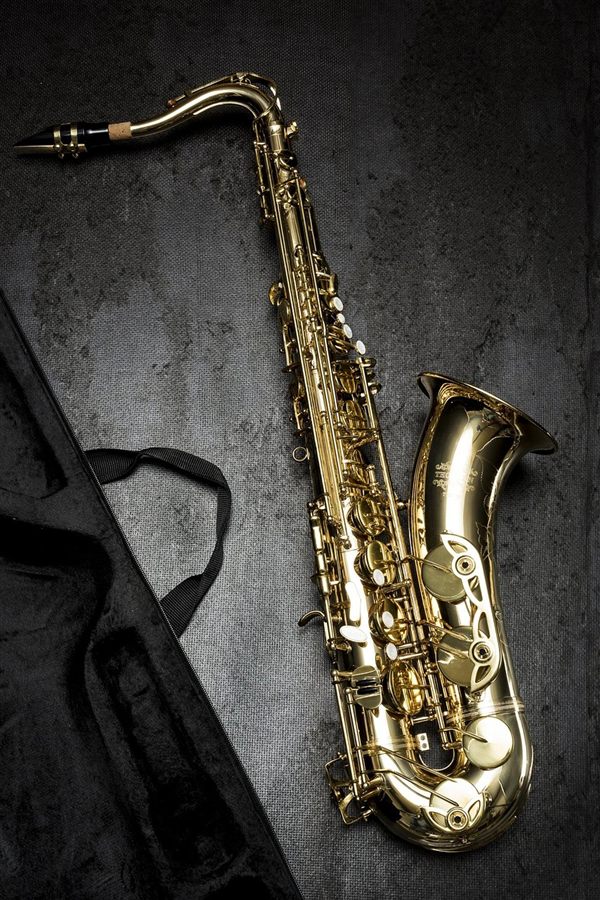
Saxophone
Yanagisawa AWO10
Price: 3.167 EUR – 3.167 EUR
Price history
Cheapest seen
Most expensive seen
Availability: 0/10 (Very rare)
The entry point into Yanagisawa's professional WO series, carrying the same re-engineered bore and fully ribbed brass construction as the company's higher-tier altos, positioned in Japanese dealer comparisons as a heavier, more centered-sounding sibling to the brighter, lighter A-WO1.
About the Yanagisawa AWO10
The AWO10 replaces Yanagisawa's earlier A991 series as part of the WO line introduced for altos in 2014, carrying the re-engineered bore, tone-hole taper and tone-hole placement that the whole series is built around - changes the manufacturer credits specifically with clearer intonation across the range. Its fully ribbed brass body solders reinforcing strips onto the main tube, with key posts (pillars) mounted onto those ribs rather than directly into the body - a construction method dealers consistently describe as adding body and stability to the tone compared to posts mounted straight onto the bare tube. The mechanism includes a Teflon-lined inner octave system, a connected C#/Bb table key, a tri-point balanced bell brace, blue steel springs and waterproof pads, available in standard gold lacquer (AWO10) or unlacquered raw brass (AWO10U). Within Yanagisawa's own WO alto lineup, Japanese dealer comparisons place it as a 'heavy-type' model - a lower tonal center of gravity and more resistance than the lighter A-WO1 - sitting below the bronze-brass A-WO20 and the solid-silver flagship A-WO37, though dealers are careful to frame this as a difference in character across genres rather than a strict quality hierarchy.
Where to buy
-
Reverb NO TARIFFS - Yanagisawa A-990u Silver Alto Saxophone 3.167 EUR Best price View details
No platform selected – pick at least one above.
Some links below are affiliate links. We may earn a commission at no extra cost to you.
Source: https://reverb.com/item/95509088-no-tariffs-yanagisawa-a-990u-silver-alto-saxophone
Sound character of the Yanagisawa AWO10
A Japanese dealer's side-by-side test-play description placed the AWO10 as a 'heavy-type' alto with a lower tonal center of gravity than the lighter A-WO1, calling its character 'brilliant and lustrous' against the A-WO1's brighter, more sparkling quality, with firm resistance paired with a stable, core-driven tone particularly well suited to solo work and powerful enough presence for concert band or big band settings. A detailed customer review offers a genuinely contrasting take, describing the same instrument's tone as neutral, centered and dry with limited room for expressive modulation, and specifically finding it less suited to jazz, rock, pop or funk playing than a budget alternative they'd been using - going so far as to call playing it a chore by comparison. That gap between a dealer's solo/concert-band framing and one player's dry, limited-modulation impression is worth taking at face value rather than resolving into a single verdict: it points to a focused, controlled tonal character that different players and genres will respond to very differently.
What owners of the Yanagisawa AWO10 say
The AWO10 holds a solid 4.6 out of 5 from a small sample of 7 Thomann ratings, with most written reviews unreservedly positive - praising intonation, response, build quality and ergonomics with little to no qualification, including one player with smaller hands who found nothing at all to criticize. One considerably more detailed review offers a sharp counterpoint worth weighing seriously: a returning adult player who'd previously owned a Yamaha YTS-62 confirmed the build quality matched that benchmark, but found the tone neutral, centered and 'dry' with little room for expressive modulation, concluding it suited their hands far better than their playing style (jazz, rock, pop and funk) and summing it up as 'more expensive doesn't necessarily mean better' for their specific needs. That split - unanimous praise for build and ergonomics against genuinely divided opinion on tonal character - suggests the AWO10 is a dependable, well-made instrument whose sound profile rewards certain playing styles (solo, concert band, big band) more than others, rather than being a universally 'best' choice regardless of genre.
Playability & handling of the Yanagisawa AWO10
A Japanese dealer's hands-on comparison described the AWO10 as resonating through the whole body with fine, detailed vibration (as opposed to the lighter A-WO1, where resonance concentrates more around the neck joint), giving it firm resistance alongside a stable, core-driven feel well suited to solo playing. Customer reviews split sharply on the result: several short reviews praise easy blowing, light key action and achievable intonation without reservation, and one player with smaller hands specifically found nothing to criticize, including how well the tighter key spacing suited her hand size. A much more detailed review from a returning adult player - previously on a Yamaha YTS-62 and two budget Thomann-brand horns - agreed the build, welds and lacquer were flawless and comparable to the YTS-62, and praised the light action and close key spacing for smaller hands, but found noticeably higher back pressure than the budget horn and specific intonation quirks: middle C# came out better than on the cheaper instrument, but the octave-key transition to middle D ran too high and middle A sounded dull and strained. That same reviewer's conclusion - ergonomically a good fit, musically not quite right for their style - is a useful reminder that even strong build quality doesn't guarantee a tonal match for every player's genre and taste.
Recommended accessories & strings for the Yanagisawa AWO10
One detailed owner review specifically recommends swapping the stock mouthpiece, which they found dull-sounding - their own Meyer 7J gave poor intonation, while a Meyer New York 6M produced the best result, suggesting mouthpiece matching matters more here than a one-size-fits-all stock solution. The same reviewer found the included case too heavy and would prefer a lighter aftermarket option, and considered the included accessories sparse overall, specifically suggesting cleaning swabs and a padded, spacer-equipped neck strap as sensible early additions rather than relying on what ships in the box.
Technical data for the Yanagisawa AWO10
| Body material | Brass, fully ribbed construction |
|---|---|
| Bore/tone holes | Re-engineered WO-series bore and tone-hole taper/placement |
| Octave mechanism | Teflon-lined inner octave system |
| Keywork | Connected C#/Bb table key, tri-point balanced bell brace |
| Springs | Blue steel |
| Pads | Waterproof |
| Finishes | Gold lacquer (AWO10) or unlacquered brass (AWO10U) |
| Line | WO series (introduced 2014), replaces the A991 series |
| Controls | No electronic controls - tone shaped entirely by embouchure, reed/mouthpiece choice and key mechanism |
Price history for the Yanagisawa AWO10
Cheapest seen: 3.167 EUR · Most expensive seen: 3.167 EUR
Cheapest seen
Most expensive seen
The history of the Yanagisawa AWO10
Yanagisawa positions the AWO10 as the standard-material entry point into its professional WO series, sharing the series' engineering rather than offering a simplified design.
About Yanagisawa as a manufacturer
Yanagisawa's story began in 1894, when Tokutaro Yanagisawa started out repairing imported woodwinds for Japanese military band musicians - a repair business that grew into Japan's first woodwind instrument factory. His son Takanobu built the company's first saxophone prototype in 1951, and the company went on to build a reputation on material experimentation few competitors matched, including the first solid-silver saxophone in 1972 and phosphor-bronze models from 1992. The AWO10 sits at the entry point of the WO series introduced for altos in 2014, replacing the long-running A991 line and carrying the same re-engineered bore as the company's pricier bronze (A-WO20) and solid-silver (A-WO37) alto models - evidence that Yanagisawa extends its core acoustic engineering across the full alto range rather than reserving it for flagship instruments alone.
Related guides
Buying a Used Saxophone: What to Check
View details
Alto, Tenor, Soprano: Which Saxophone to Start On
View details
Vintage Saxophones From Major Makers: What Collectors Look For
View details
Matching Mouthpiece and Reed: How Tip Opening and Reed Strength Work Together
View details
Saxophone Overhaul: What a Full Pad and Cork Replacement Actually Involves
View details