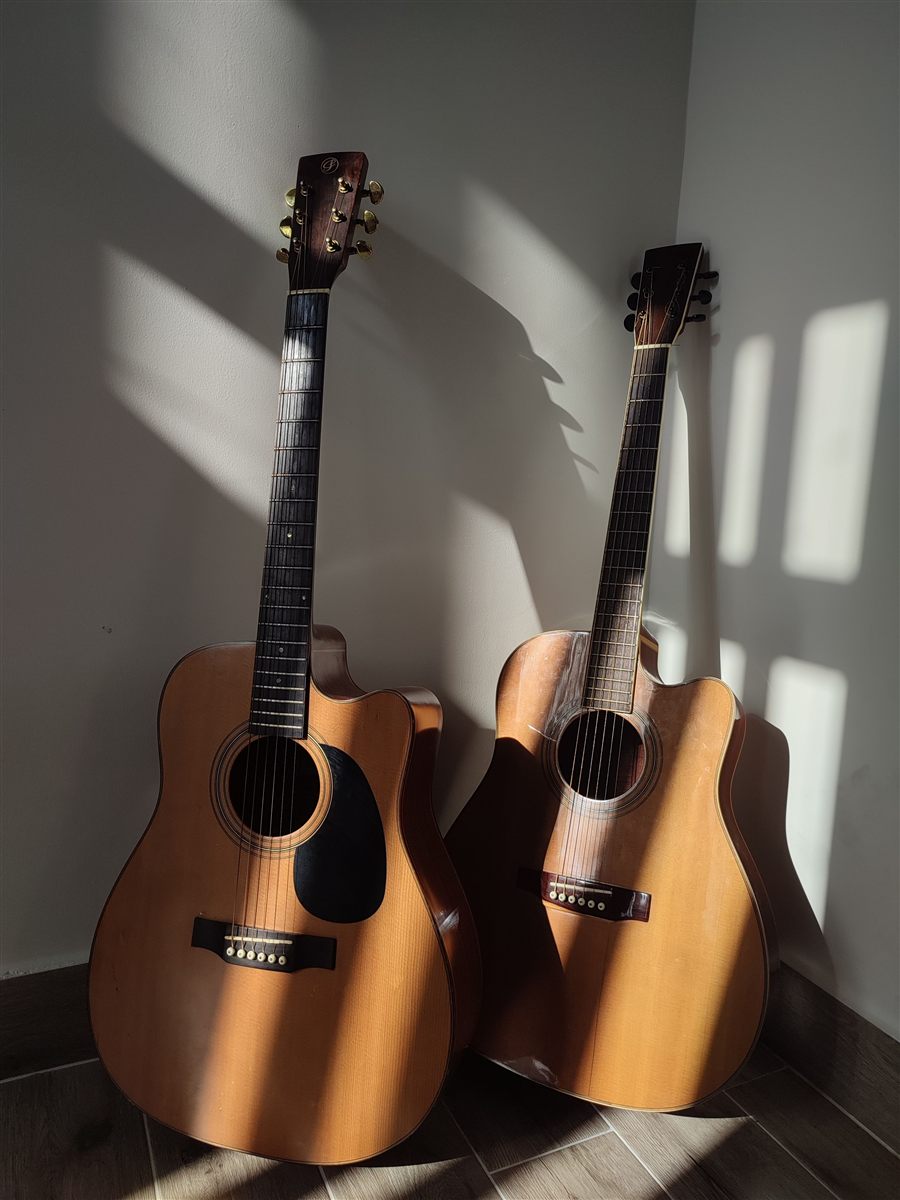
A used steel-string acoustic is a good buy when the neck, top, bridge and bracing are structurally sound. Almost everything else (frets, nut, tuners, setup, finish scratches) can usually be fixed for two- to three-figure sums. So check the expensive items first, add the likely repair bill to the asking price, and only then decide whether the offer works.
Inspection order and questions for the seller
The inspection order at a glance
- Overall impression, storage history and signs of repair
- Neck: straight, truss rod with reserve, neck angle
- Top: belly, sinking, bridge lift
- Cracks and loose bracing
- Frets, nut, action, tuners
- Electronics, finish, originality, serial number
- Play test, ideally on fresh strings
The order is deliberate: checking structure first saves you the time of falling for a guitar that fails on a deal-breaker anyway.
Questions for the seller
- How was it stored (case, living room, basement, attic, near heating)? Climate damage is the most common cause of cracks and distortion, see humidity and storage.
- Any repairs: neck reset, glued cracks, a neck break, a refinish? Ask for the shop invoice.
- Are the nut, saddle, tuners, bridge pins and pickup original?
- What is the action, and when was the last setup?
- Is there a serial number, original case and proof of the first purchase?
Neck: straight, with reserve, correctly angled
Straightness and relief
Hold the guitar in playing position and sight along the strings from the nut. A slight dip (relief) is normal; a kink, wave or twist is not. For a more precise reading: put a capo on the 1st fret, press the low E string down at the 14th fret and slide a feeler gauge between string and fret at the 7th to 8th fret. The thickest blade that still slips through with slight resistance is the relief value. As a rough orientation for judging a guitar, the usual figure is a gap of roughly a quarter of a millimetre (about 0.010 in) at the 7th to 8th fret. These are ranges rather than standards, and the exact value depends on the guitar and the player.
Truss rod
An adjustable truss rod should still have room to move in both directions. If the adjustment is at its limit, you hear cracking noises when it is turned, or the neck is twisted, be careful: a twist cannot be fixed with the rod. When adjusting, work only in small steps (an eighth to a quarter turn), let the neck settle in between and stop at once if you meet resistance; if in doubt, leave it to a workshop. The procedure is covered in detail in action and neck relief diagnosis. Not every acoustic has an adjustable rod: very old guitars and some classical models have only a reinforcement or nothing, so relief cannot be changed.
Neck angle
This is the item buyers miss most. After decades of string pull the neck tilts forward, the action creeps up, and the saddle gets sanded lower and lower. Warning signs are high action on a saddle that barely sticks out of the bridge, and a straightedge laid along the frets that ends below the top of the bridge instead of just above it. A reset is generally due when the saddle cannot go any lower and the action stays high, typically on 30- to 40-year-old instruments. Whether a reset is feasible depends on the joint: a dovetail is more work, bolt-on systems (as on Taylor models) are simpler to adjust. A neck reset is specialist work. Some beginner guides advise against buying any guitar that needs a reset at all, because the cost quickly approaches the guitar's value.
Top and bridge: belly, sinking and bridge lift
Belly and sinking
Sight across the top with your eye level with the surface, and lay a straightedge across the lower bout behind the bridge. A slight belly behind the bridge is normal on nearly every played guitar. Worrying are a pronounced belly, a depression in front of the bridge or between bridge and soundhole, and a bridge visibly tilting forward. Online lore tolerates a few millimetres of deflection as a rough guide; that is practical experience, not a manufacturer standard. A strong belly points to weakened or detached bracing, see bracing and X-bracing. Over-dry storage can result in a sinking top, sharp fret ends and cracks. Fret ends sticking out at the fingerboard edge suggest the guitar has been stored dry for a long time.
Bridge lift
Look closely at the back edge and corners of the bridge and try a card, a sheet of paper or a thin feeler gauge underneath: if you can see a gap or anything slips in, the glue joint is open. A lifting back edge is a serious warning because it tends to progress. It is repairable, though, and among the cheaper structural jobs (see costs). The question is whether only the bridge is loose or the top under it is damaged too. Frayed pin holes, or a torn or bent bridge plate seen through the soundhole, make it more expensive. Regluing is a job for a workshop.
Cracks and loose bracing
Finish checks and wood cracks
- Finish checking: Fine hairlines in the lacquer that do not reach the wood are cosmetic, especially on older nitrocellulose finishes. They do not hurt tone or stability.
- Wood cracks along the grain in top, back or sides are structural. Clean cracks with flush edges are often not a deal-breaker and can be repaired by a workshop; small, clean cracks are generally acceptable.
- Offset: If you feel a step between the edges, the wood has shifted; the repair is more demanding and the result more visible.
- Dark, gaping cracks have been open for a long time and collected dirt. That makes an invisible repair hard and hints at poor storage.
- Cracks near the bridge, neck joint, headstock or end pin: More critical, because string pull or leverage acts there. Suspicious cracks in those places count as walk-away items until a pro has looked.
- Cracks running across bracing are more work than simple lengthwise cracks (roughly double the price, as a rule of thumb).
Run a fingernail over each crack, shine a flashlight into the soundhole and look for glue traces inside; they show where repairs were made. A repaired crack is not automatically bad, a cleanly repaired crack often holds better than the surrounding wood. Ask who did it.
Loose bracing: tap test
Tap the top and back with your knuckles. The sound should be clean and dry everywhere. Buzzing, rattling or dull spots point to loose braces. Also press very gently on the top with a flat hand: a creak suggests unglued bracing. Never press hard. A flashlight and a small mirror through the soundhole help you see glue joints. One loose brace is fairly cheap to repair (see costs); several loose braces plus a belly suggest a bigger problem.
Frets, nut, tuners and action
Frets, nut, tuners and saddle
- Frets: Grooves under the strings in the lower positions or flattened crowns mean wear. Some wear is normal. A fret dress is inexpensive, a full refret much more. Many previous dressings show as low, flat frets.
- Buzz: Play every fret up to the top. A buzz at one spot means a single high fret. A buzz over a large area can come from relief, bridge lift or neck angle.
- Nut: Strings should neither rattle (slots too deep) nor sit too high (stiff first position). A nut is cheap to replace.
- Tuners: Turn each way: smooth, no slop, holding pitch. If a tuner wobbles, you can carefully tighten its mounting nut on the button, no more than hand-tight with a fitting wrench. If a guitar does not hold pitch, old or badly wound strings are often the cause rather than the tuners. Faulty tuners are negotiable and cheap to replace. Re-drilled or filled holes in the headstock indicate earlier conversions.
- Saddle and bridge: A heavily sanded saddle or shaved bridge hints at earlier workarounds for neck angle. More on materials in bridge and saddle.
Judging the action
The figures found online vary widely: for beginner guitars, around 3 mm at the 9th fret is often called the upper limit, while some sources accept up to about 5 mm at the 12th fret on steel strings. For a well-set-up guitar, about 2.4 mm (low E) and 1.6 mm (high E) at the 12th fret are common orientation values. Treat all of these as rough guidance for judging a guitar, not as targets. What matters is not the exact figure but the reserve: high action with an already low saddle means the guitar has no room left; high action with plenty of saddle left is a cheap setup issue. To measure, lay a fine steel rule or an action gauge on top of the 12th fret and read the distance to the underside of the string. The 2:1 ratio helps you estimate reserve: to lower the action at the 12th fret by 1 mm, the saddle has to lose about 2 mm at its underside. How to adjust action is covered in action and neck relief diagnosis. A workshop can also tell you quickly how much reserve is left.
Electronics, finish, originality and authenticity
Electronics, finish and original parts
- Pickup and preamp: Plug in, turn every control and wiggle the cable. Scratchiness or dropouts are usually cheap to fix, but cutting-out electronics are a standard inspection point. Check the battery and the jack area for cracks, since the jack hangs on the end block. A retrofitted system means a hole in the side, which may show repair marks.
- Finish: Even original lacquer is a plus. A refinished guitar is commonly valued at well below one with the original finish, even if that is scratched (a rule known mostly from electrics; similar logic applies to acoustics). Look for colour mismatch, brush marks and lacquer in the soundhole edges.
- Originality: Original parts raise the value of collectibles, but on player guitars function matters most.
Serial number, authenticity, warranty
On Martin guitars, model designation and serial number are etched on the neck block inside and can be dated online; some manufacturers do not appraise used instruments or vouch for sellers' claims. A serial number alone does not prove authenticity: compare headstock shape, inlays, label and workmanship with the features of the claimed model and year, and be sceptical of offers far below market price. Warranties are often limited to the registered original owner and are not transferable (as of Oct. 2026). So do not count on a manufacturer warranty on a used guitar. For questions about warranty and withdrawal rights, ask the relevant consumer advice service, and have the seller's statements about condition confirmed in writing.
Solid or laminate, prices and depreciation
Solid tops generally sound better and develop with age, laminate is more robust against climate swings (see tonewoods). For used buying that means: laminate guitars crack from climate less often, but lose more value because they hardly improve. Roughly: entry-level new guitars are mostly laminate, the mid-range is mixed, and from the upper mid-range up the tops are mostly solid.
Rules of thumb for used prices: roughly 30 to 50 percent below retail is often quoted (as of Oct. 2026). That is a rough range, not a price: brand, age, model and condition shift it strongly, and collectibles can sell above new price. Price guides for used instruments and current listings help with valuation. Comparing identical models at a reputable dealer and in current listings is the most reliable yardstick.
Buying online or in person
Online versus in person
A guitar is an individual: two examples of the same model play and sound differently. Beginners are generally advised against buying untested. In person you can inspect, listen and haggle. Online you need more safeguards: many photos (back edge of the bridge, inside the soundhole, neck heel, back of the headstock), a video playing all positions, the action in mm at the 12th fret, the exact serial number and a clear return policy. For shipping, the strings should be slightly slackened and the guitar belongs in a hard case inside a padded box, because transport damage hits neck and headstock; in winter it needs several hours to acclimatise in its closed case before being played. Consumer rights differ by country and between business and private sellers, so check the terms for your case and get promises in writing.
Play test
- Tune up and see whether it holds pitch.
- Play every string at every fret up the neck to find buzzes.
- Check intonation: the 12th-fret harmonic should match the fretted note.
- Measure the action at the 12th fret and check whether the saddle has reserve left.
- Play chords open and barre, and listen for rattles.
- Compare volume and tone across strings; holes in the sound or dead notes suggest structural or bracing problems.
- Bring a second person to listen while you play. Old strings make any guitar sound worse: judge on fresh strings if you can.
Repair costs at a glance
All figures are indicative (as of Oct. 2026) and vary by shop, region and effort. Shops often list entry prices, so get a quote before you commit.
| Job | Typical range (USD, as of Oct. 2026) |
|---|---|
| Acoustic setup | 60 to 125 |
| Bridge reglue | 150 to 300 |
| Glue a crack | 50 to 400 (length, location) |
| Reglue a loose brace | 60 to 300 |
| Fret dress and polish | 50 to 220 |
| Full refret | 250 to 650 |
| New nut | 60 to 130 |
| Neck reset | 350 to 1,000 (typically 450 to 800) |
The neck reset has the widest spread: figures range from about 400 to 800 USD, considerably more combined with a refret. Taylor bolt-on guitars are a special case: the neck angle adjustment is part of the manufacturer's factory service package (roughly $280 to $330). Refinishing a top or a whole guitar is a separate, considerably more expensive job: varies by shop, get a quote.
Deal-breakers, budget and common mistakes
Deal-breakers or negotiable?
- Usually walk away: twisted neck, truss rod at its limit with no reserve, bridge lift with damaged top, strongly domed or sunken top with high action, suspicious cracks at neck joint, headstock or bridge, several loose braces, a neck reset that exceeds the guitar's value, inconsistent serial number or provenance.
- Negotiable: light fret wear, setup needs, nut, tuners, scratchy electronics, finish scratches, one clean crack, a loose bridge on an intact top.
The real price of a used guitar is the purchase price plus the work needed to make it reliable and playable. A pre-purchase check by a luthier is worth it when the guitar stretches your budget, structural doubts exist, fret condition is unclear, or you buy online with a short return window.
Budget and care after the purchase
Plan at least for new strings (string types compared) and a professional setup (roughly $60 to $125 depending on the shop, as of Oct. 2026), plus cleaning and fretboard care. If you play in heating season, add a hygrometer and humidifier. If you are unsure about body shape or string count, body shapes and 12-string vs 6-string help with the choice. A basic setup commonly starts at around $65. On top comes whatever the inspection turned up.
First care after buying
A few simple steps bring a used guitar to a clean starting point:
- Change the strings: Replace them one at a time so neck tension stays even. Put the ball end in the bridge hole, seat the bridge pin with its groove facing the string and pull gently on the string until the ball sits against the bridge. Feed the string through the tuner post, wind two to three turns side by side downward and bring it up to tension. Retune and stretch the new strings a few times until the pitch holds.
- Clean fingerboard and body: Wipe off dust and sweat with a soft cloth. Unfinished fingerboards can take a little of a product made for the purpose when dry; lacquered surfaces only need a soft, dry or slightly damp cloth. Follow the care notes for your guitar.
- Check the climate: A hygrometer in the case or room shows whether the air is right; a salt test is a simple way to check it. The background is in humidity and storage.
Common mistakes when buying used
- Buying on looks and sound alone and not checking neck, bridge and top.
- Taking old strings as the guitar's sound.
- Judging a low price without the repair costs.
- Writing off a low saddle problem as a setup matter when it is a neck angle problem.
- Skipping photos of the back, neck heel and soundhole interior when buying online.
- Expecting a manufacturer warranty.
- Unpacking a cold guitar and tuning it right away.