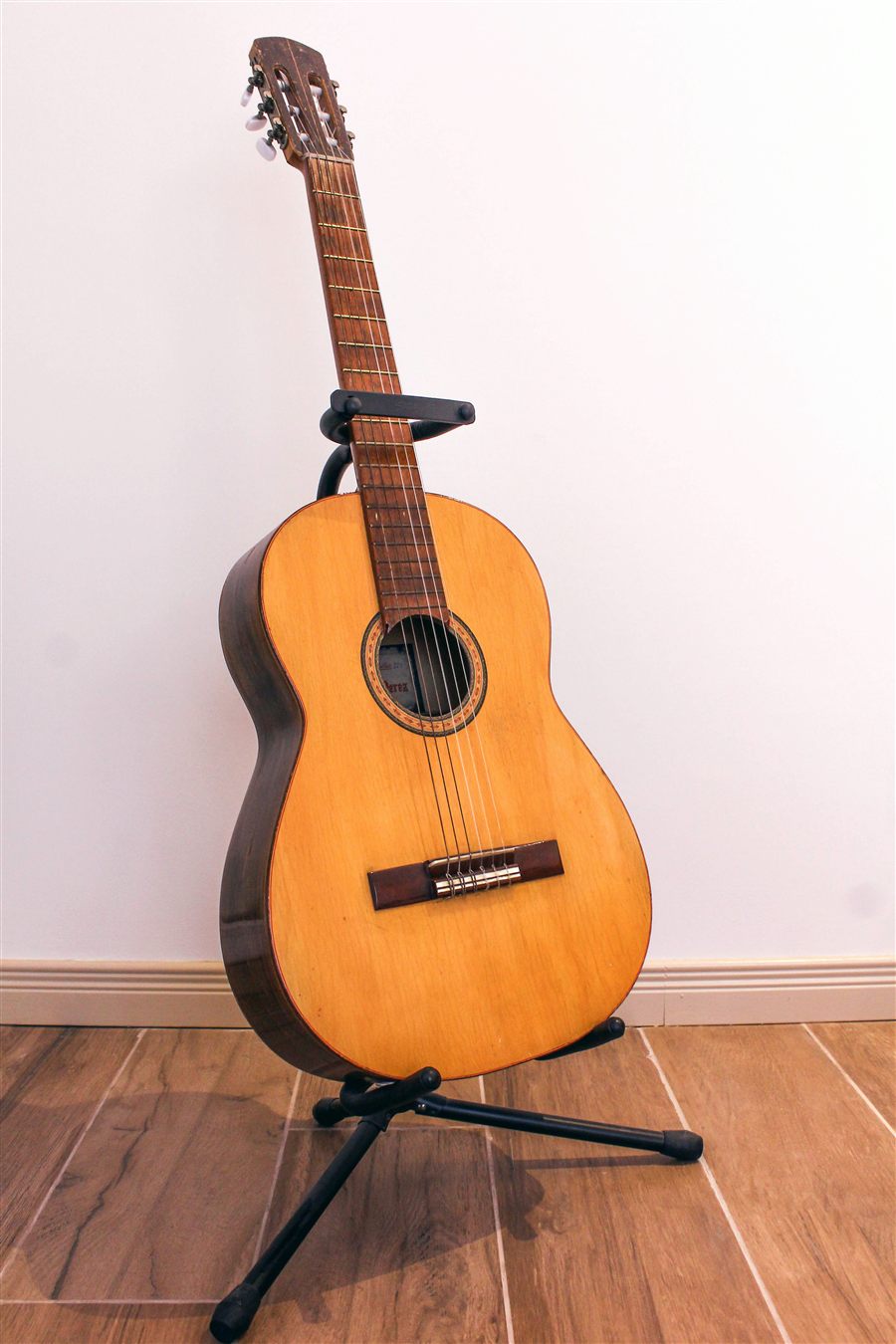
Fan bracing is the system of thin wooden struts glued to the inside of a classical guitar's top. The struts fan out below the soundhole, hold the top against string tension and, at the same time, shape how it vibrates. The pattern is credited to the 19th-century Spanish maker Antonio de Torres and is still the standard. Separate from it is the question of Spanish versus violin-maker-style construction, which describes how neck, sides and back are joined to the top. Both affect tone and repair effort, but rarely decide a purchase on their own.
What the bracing does inside the top
The top takes the string vibration through the bridge and turns it into sound. Torres recognized that the top, not the back and sides, defines a guitar's voice, and built accordingly. To let such a thin plate survive and still move freely, it needs a framework with three jobs.
- Structure: The combined pull of six nylon strings is on the order of 45 to 60 kilograms, roughly 100 to 130 pounds (rule of thumb). The struts spread this load so the top does not bulge behind the bridge or sink in front of it.
- Deliberate stiffness: The top should be stiff along the grain and more compliant across it. The strut layout decides which zones are stiffer and which move more, and with that which frequencies the top radiates well.
- Tonal signature: Placement, height and width of the struts are part of a maker's handwriting. Two guitars with the same pattern can sound clearly different.
Because nylon strings pull much less than steel, the top can be thinner and lighter-braced than a steel-string guitar's X-braced top. That contributes to the rounder, less percussive attack. The comparison of the two string types is covered in nylon versus steel strings on a classical guitar.
The Torres layout: fan struts, bars and patch
The parts
The classic pattern consists of several groups of struts, all glued to the underside of the top.
- Fan struts: Seven slender struts spread out like a fan under the lower part of the top, toward the bridge and lower bout. Seven is considered the standard count for the traditional Spanish layout.
- Harmonic bars: One upper and one lower bar cross the top, above and below the soundhole. The upper one is usually stiffer than the lower. They contribute substantially to the treble response.
- Angled struts: Two diagonal struts connect the bars between the soundhole and the fan.
- Closing struts and soundhole patch: Struts at the sides close off the pattern, and a reinforcement around the soundhole (the patch) helps keep the rosette area from cracking.
On good instruments, top thickness is tuned together with the struts: roughly 2 mm in the center, thinning toward the edge (rule of thumb). How finely a maker tunes this is a matter of experience, not of tables.
How many fans are right?
In practice you will meet 3, 5, 7 or 9 fans, across all price classes. The earliest fan-braced guitars had a few short struts, around 1850 five became common, later six, seven and more were added. A higher count is not automatically better. Three fans save labor and show up on budget guitars more often; some makers choose nine narrow fans so the struts leave less visible imprints on the top as humidity changes. Strut length, height, material and angle matter just as much. Asymmetric patterns exist too, leaving more or less wood on the bass and treble sides to shape each half on purpose.
As a rule of thumb, builders report that spruce tops often get by with simpler layouts because they can otherwise turn bright, while cedar tends to need more stiffness from the bracing. How the two woods differ in sound is explained in cedar versus spruce on a classical guitar. On flamenco guitars some makers leave out the outer struts so the top is more flexible across the grain; see flamenco versus classical guitar.
Variants at a glance
Besides the fan pattern there are modern constructions that chase the same goal (more volume and projection without losing durability) by different routes. The table sorts them roughly. The tone notes are tendencies, not guarantees: the maker and the individual guitar weigh at least as much as the system.
| Construction | Build | Tonal tendency | In practice |
|---|---|---|---|
| Fan (Torres) | Solid top with fan struts, harmonic bars, patch | Vocal, nuanced tone with a strong fundamental; needs more technique to fill large halls | Standard, any luthier can repair it, all price classes |
| Lattice | Very thin top with a fine grid of struts, often carbon; back and sides tend to be heavy | Lots of volume, projection, sustain, even response; can sound harder | Mostly concert instruments from master builders, often much more expensive |
| Double top | Two very thin wood skins around a honeycomb core (usually Nomex) | Between fan and lattice: powerful, fast response, warm | Lighter than a solid top of the same size, less climate-sensitive; new prices usually start in the four-figure range |
| Special designs | For example Kasha-type construction (developed from an impedance-matching idea, 1970s), asymmetric fans | Varies widely by maker | Rare; trying one matters more than any description |
The double top is credited to the maker Matthias Dammann, who built the first Nomex-core version in 1995. Lattice bracing comes from the Australian Greg Smallman. For a normal purchase under about $1,000 neither matters: fan bracing is the rule there. What separates a master-built instrument from a factory one is covered in factory-made versus handmade guitars.
Spanish versus violin-maker-style construction
Spanish construction
The term describes an assembly order. Neck and heel are carved from one piece and joined with the block, and the sides slot into that unit. The top, neck and sides first form a rigid assembly; the back goes on last. The neck is thus tied firmly into the structure of the body. For the builder this has advantages: neck angle and alignment can be fixed early, and production is efficient, which is why many workshops and even some factories build this way.
Violin-maker-style (Central European) construction
It has its roots in violin making. The closed body is built first, and the neck is fitted and inserted afterward, usually by a dovetail or similar joint. That is less work and therefore cheaper. Hermann Hauser I (1882 to 1952) carried Torres' method into Central Europe, and many master builders there worked with their own designs, so their guitars cannot be written off as inferior. Modern factory instruments also use bolted joints in some cases. When a seller mentions the construction type, ask what exactly is meant, because the terms are used inconsistently.
Does one sound better?
It is often said that the Spanish joint transfers vibration more directly from neck to top. That is weakly supported by measurements; most sources online agree that craftsmanship, wood and the tuning of the top shape the sound more than the neck joint. A guitar is not better because it is built the Spanish way and not worse because the neck is fitted into a closed body.
Durability and repair
The Spanish heel is very stiff and robust against knocks. Its drawback shows up decades later: if the body distorts and the neck slowly tips up, string height gets too high and the correction is laborious because the neck cannot simply be removed. Depending on the case, shops handle it by working on the heel, the fingerboard, or by lowering the bridge and saddle. A dovetail joint is easier to reset. Which method applies is for a repair shop to decide after inspecting the guitar. At this structural spot the rule is: do not intervene yourself.
Recognizing a bracing problem
Typical signs
Loose braces are fairly rare but a known annoyance. Triggers are a knock or glue that fails with age, often helped by climate swings. Clues:
- A rattle, buzz or hum that appears only on certain notes and coincides with the string being struck, often in the middle of the fingerboard on the low strings.
- A note that is normally clean suddenly sounds dull, papery or cut off.
- The top bulges noticeably behind the bridge, the bridge tilts, or string height rises for no obvious reason.
- Cracks in the top along the grain, especially around the fan area (the struts are meant to stabilize such cracks).
Checking without risk
Before suspecting a loose brace, rule out the simpler causes. That is harmless and often saves a shop visit.
- Strings and nut: Old, uneven strings, loose knots at the bridge or a poorly seated nut cause similar noises.
- Frets and string height: A high fret or too little relief buzzes on one note or one region of the string.
- Tuners: Loose tuner nuts or bushings vibrate along.
- Tap test: Hold the guitar by the neck and tap firmly, but not hard, on the bridge and around the top. A clear tone is a good sign; a papery rattle mixed into the thump points to a loose brace or seam.
- Look through the soundhole: With a flashlight and a small inspection mirror you can see parts of the bracing. Look for dark gaps along a strut, flaking glue and fine cracks. Do not reach in, do not insert tools, do not shake the guitar.
If you see something suspicious or the noise stays unexplained, a repair shop is the right place. Regluing a loose brace is not a hobby job: the gap has to be cleaned properly, the right glue applied and the strut clamped under pressure, in a spot you can hardly reach. Done wrong, it can damage the top or change its structure.
What the shop does and what it costs
For a loose brace the technician cleans the joint, removes old glue, works fresh glue in and clamps the strut. Cracks add further work, such as gluing the seam or an inner reinforcement. The cost depends mostly on how accessible the spot is.
- Loose brace reglue: Estimates of roughly $150 to $300 are reported, depending on access (rule of thumb, Oct. 2026). Quotes vary by shop, get a quote.
- Crack repair: Typically about $50 to $150 for a simple seam; with finish touch-up shops quote around $175 to $300 (rule of thumb, Oct. 2026).
- Bridge reglue: Around $150 to $300 (rule of thumb, Oct. 2026).
- Neck reset: For guitars with a removable neck, estimates run from about $350 up to roughly $1,000 (Oct. 2026). For a Spanish heel it depends on the method, one reported case of cutting and shimming the heel cost about $350, other shops quote much more: varies by shop, get a quote.
Many shops quote only after seeing the instrument. If a repair would exceed the guitar's value, talk about alternatives; on a budget student guitar usually only small repairs make sense.
When buying, especially used
The bracing pattern is rarely a selection criterion, but condition is. On a used guitar check:
- Tap test and playing in all positions: rattling is a warning sign.
- A look through the soundhole: cleanly glued struts all the way, no lifting ends, no cracks. On handmade instruments the struts are usually neatly shaped, on factory instruments often rougher. A rough interior alone is not a defect.
- Top and bridge: no pronounced bulge behind the bridge, no gap under the bridge, no cracks.
- String height and neck angle: if the saddle is already very high and the strings are still high, the neck may have tipped, which can become expensive with a Spanish heel.
More on the overall picture when buying used is in buying a used classical guitar: what to look for. On whether solid wood is worth the extra cost, see solid wood versus plywood on a classical guitar.
Common myths
- "More fans are better." No. The count says little; what matters is the interplay of layout, wood and top thickness.
- "Spanish construction sounds better." Unproven. It is a building tradition with pros and cons, not a tone guarantee.
- "Violin-maker-style construction means bolted and cheap." It originated as a violin-making tradition with an inserted neck, and many master instruments use it. Bolted joints are more a modern factory matter.
- "Double tops are fragile." The honeycomb structure is generally regarded as climate-stable. The skins are very thin, though, so an impact behaves differently than on a solid top.
- "Rattling always means the bracing." Most of the time it is strings, frets, nut or tuners. Only when those are ruled out does the brace come into question.
- "I can fix that with wood glue myself." That is risky precisely because it affects the structure of the top; poorly placed glue or clamping errors make the damage worse.
Prevention: climate and care
Most glue joints do not fail suddenly but through repeated humidity swings: dry heated air shrinks the wood, damp air swells it. A rule of thumb for storage is 40 to 55 % relative humidity at room temperature. A small hygrometer in the case shows you the values, and a case humidifier helps in winter. Avoid radiators, direct sun and the car trunk in summer. When a guitar comes into a warm room after time in the cold, let it acclimate in the case for several hours. That way the framework under the top usually stays unremarkable for decades.