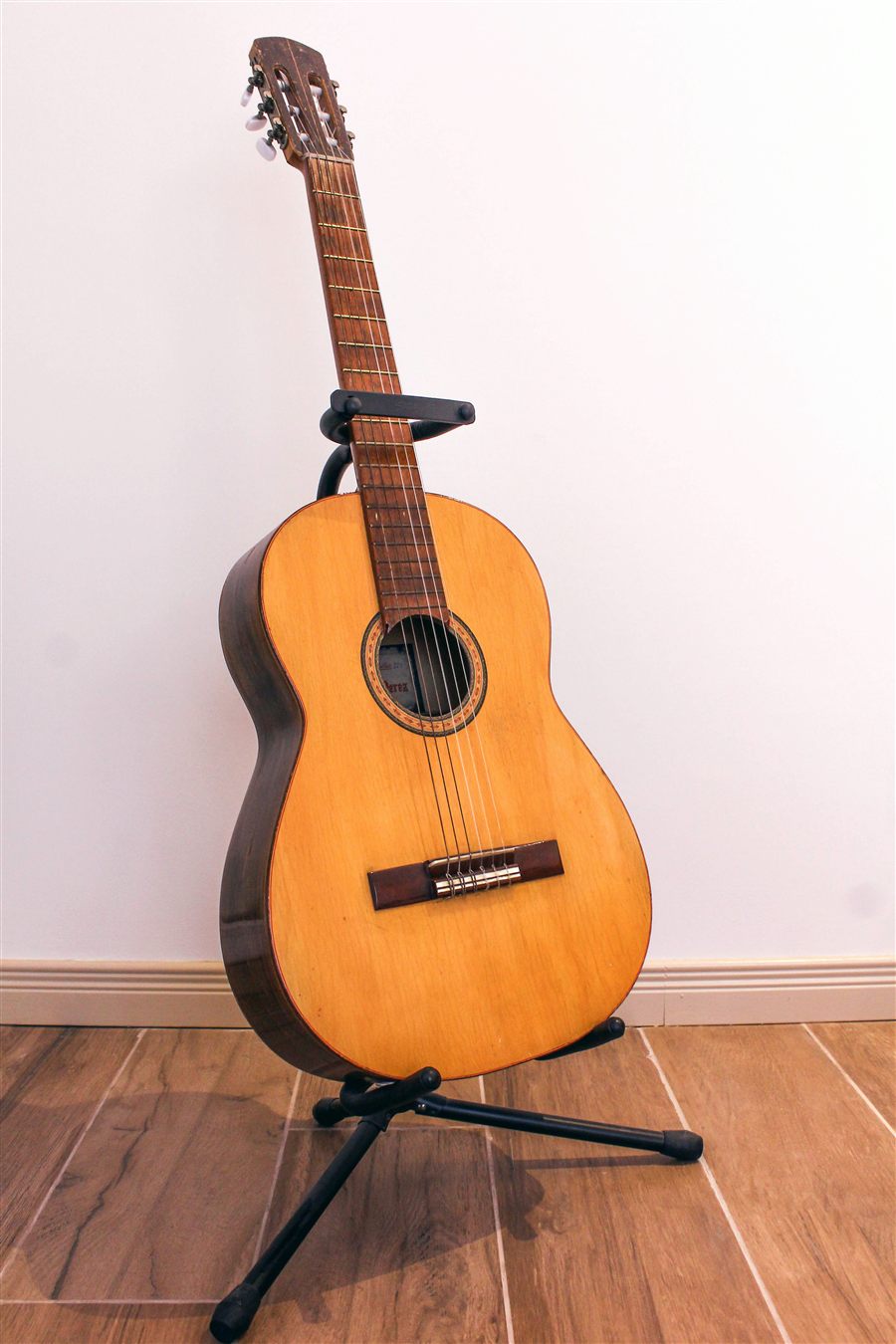
Cedar sounds warm, round and open, and it does so almost from day one. Spruce sounds brighter, clearer and more articulate, but takes much longer to show its full potential. Neither is simply better: the choice depends on repertoire, touch, room and patience, and build quality counts at least as much as the species.
The differences at a glance
| Trait | Cedar (western red cedar) | Spruce |
|---|---|---|
| Tone | warm, round, mid-focused, rich overtones, softer attack | bright, clear, overtone-rich, good note separation, focused mids |
| Response | quick and immediate | firmer, asks more of the right hand |
| Break-in | weeks to a few months | about a year to several years (rule of thumb) |
| Dynamics | best at soft to medium volume, compresses sooner when played very hard | wide dynamic range, more headroom |
| Typical repertoire | Romantic, Spanish, 20th century, home, recording | Baroque, polyphonic music, concert hall |
| Looks | reddish-brown, darkens slightly | creamy white to pale gold, yellows toward honey |
| Surface | softer, dents more easily | harder |
Tone in detail
Cedar: warm, round, immediate
Cedar is lighter, softer and more porous than spruce. That explains its voice: a full, round fundamental, sweet and soft trebles, a warm bass and plenty of overtones, all with a darker colour. The guitar fills a room with volume, sounds punchy and responds at once to a light touch. String noise such as nail scrapes or slides on the bass strings also stands out less, which is why cedar suits many beginners: it covers up small technical flaws.
The flip side: hit a cedar top hard and it reaches its limit sooner, and the tone can feel squashed or harsh. Some listeners find cedar less clear and sparkling, but with more character. For projection to the back of a large hall cedar is often considered less direct, while in an ordinary room it can actually seem a little louder because it is so rich in the mids. Both impressions exist side by side, so reports vary with room and playing style.
Spruce: clear, articulate, developing
Spruce is stiffer and denser. It sounds bright, clear and articulate, with clean separation of individual voices, a well-defined bass and focused mids. The tone is often called bell-like, with more complexity and longer sustain. It also has a wide dynamic range: the guitar stays present when played softly and has reserves when played loudly.
The price is the demand on your right hand. Spruce rewards variation: change the contact point, angle and nail shape on purpose and you get a big palette of colours. Cedar sounds more even, so it is called more forgiving, but it offers less room for colour. A new spruce top can also sound a little stiff and restrained at first.
Break-in: how long does it really take?
The sources agree on the direction, not on the duration. Cedar sounds open from the start and seems mature even when new. It opens within weeks to a few months and then changes comparatively little.
For spruce the figures range widely, from a little over a year of regular playing to several years (rule of thumb: one to five years, some claims go beyond). The usual explanation: vibration reduces the internal damping of the wood, so the top moves more freely and responds more finely. After that many players find spruce develops more overtones, longer sustain and a singing tone. How big the effect really is, is hard to measure and mostly experience-based.
In practice: when you buy a new spruce guitar you are judging potential, not just today's sound. A used, already played-in spruce guitar lets you hear what the top can do right now, which is one reason used classical guitars with spruce tops are attractive.
Playing style and repertoire
- Baroque, Renaissance, Bach lute suites, fugues: spruce. Clear voice separation keeps polyphonic lines transparent.
- Romantic and Spanish music (Tárrega, Barrios and related): cedar. Warmth and a round, singing quality suit the expression of these pieces.
- Concert hall, competitions, touring: spruce, for dynamic headroom and projection.
- Home practice, recording, small rooms: cedar, because it sounds lovely soft and medium and speaks at once.
- Beginners and returners: usually cedar, because it is more forgiving and motivates from the start. Spruce works just as well, especially if you want to work with tone colours.
These are tendencies. Playing Bach on a cedar guitar is not wrong, and many spruce guitars sound wonderful in Romantic music. What you hear matters more than any rule.
Looks, durability and care
Spruce runs from creamy white to pale gold, often with straight, fine grain. Evenly spaced growth rings count as a quality sign, and premium tops show roughly 12 to 20 rings per centimetre, which is very tight. A feature collectors like is the so-called bear-claw figure. Over the years spruce yellows under light to a honey tone. Cedar is naturally reddish-brown, with wider, less uniform rings, and darkens slightly.
Reports on durability differ. Cedar is softer and therefore more prone to dents and scratches, for example from belt buckles or fingernails. Some sources also call it more sensitive to humidity, while others consider both woods lifelong with good care. For both the same applies: a relative humidity of 40 to 55 percent is the usual target, a hygrometer in the case helps, and the guitar belongs in its case when you are not playing, away from heaters and sun. Fresh finishes, especially shellac, need a few months to cure and do not like sweat, buttons or zippers.
Spruce species and cedar in more detail
- European spruce (Picea abies; also sold as alpine spruce): the traditional benchmark in classical guitar making. It combines stiffness and low weight and sounds powerful, direct and detailed. High-grade boards are available only in limited quantity.
- Engelmann spruce: slightly lighter and less stiff, warmer and quicker to respond. It is often described as a middle way between European spruce and cedar, and it turns up on production models.
- Sitka spruce: from large trunks, consistent in grade, stiffer and heavier. Widely available, so it is common on cheaper models.
- Western red cedar (Thuja plicata, often sold as Canadian cedar): the big trunks give straight-grained cuts. The wood is lighter, softer and more porous than spruce.
The species says less about sound than the individual set of boards and the maker's voicing: two tops of the same species can sound quite different.
Thermally treated (torrefied) tops
Torrefaction heats the wood under control to imitate ageing. The idea is an open, played-in sound from the first day plus better dimensional stability. Experiences are mixed. Some makers and players really hear a more open, mature tone, while others find it clearer but flatter and less deep. The wood is also considered more brittle, particularly before bracing, and the treatment cannot turn poor spruce into good spruce. On classical guitars the topic is still fairly young, so treat it as a tonal option, not a sure improvement, and listen before paying extra. For the warmth of a played-in guitar, cedar offers a route that needs no heat treatment.
Pairing with back and sides
The top produces most of the sound, and back and sides shape it. How much the top matters is shown by a famous guitar from 1862 that Antonio de Torres built with papier-mâché back and sides and that still sounded good. The usual partners:
- Rosewood (East Indian, Brazilian, Madagascar): deep, clear bass and bright, sparkling trebles. Brazilian rosewood costs much more, and its advantage is mostly visual and in prestige. The tonal gain over East Indian rosewood is small.
- Mahogany: warm, woody, mid-focused, common on entry-level guitars. Compared with rosewood it sounds audibly thinner in the bass. With spruce it often gives a balanced, versatile voice, with cedar a particularly soft, warm one.
- Cypress: traditional on flamenco models, bright and percussive with quick decay (see flamenco vs. classical guitar).
- Maple, sapele, walnut and others: maple clear and transparent, sapele with a bit more sparkle on top, walnut and ebony more on high-end special models.
A rule of thumb: cedar plus rosewood gives a warm, deep sound with sparkle, spruce plus mahogany a balanced, direct one, spruce plus rosewood a particularly brilliant, powerful one. It is a tendency, slightly overridden by construction and bracing (see fan bracing explained). Less common are double tops (two thin plates with a layer between them) and carbon lattice bracing, which change the sound independently of the top species.
Solid or laminate: briefly
Both woods come as solid tops and as veneer or laminate tops. Solid tops vibrate more freely and develop with playing, laminate ones do not. In the US, entry-level classical guitars with consistent quality cover roughly 300 to 1,000 USD (as of Oct. 2026), and solid tops are standard in that range. For everything else see solid wood vs. plywood on classical guitars.
Prices: what does the difference cost?
The top species itself barely sets the price. On entry and mid-range models the cedar and spruce versions of the same model cost about the same, and what matters is construction, back and sides, origin and finish. Rough guides for the US (as of Oct. 2026):
- About 280 to 450 USD: a common production classical with a solid cedar top and mahogany body, new or used.
- About 470 to 650 USD: next step up with a solid cedar or European spruce top and rosewood back and sides; street prices for the two top variants of the same model differ only by a few dollars.
- 300 to 1,000 USD: the entry-level range with consistent quality from established factory makers.
- From about 3,000 USD: handmade by a luthier with premium woods and custom hardware.
Prices vary by shop and over time. High-grade European spruce and handwork raise the price because of wood quality, not because of the species alone. More on production vs. handmade in factory-made vs. handmade.
Compare them yourself: a test-play guide
- Create equal conditions: same strings, similarly fresh, same seating, same pieces. Old strings fake differences.
- Form a sound ideal first: listen to recordings and concerts beforehand to know what you want, and judge each guitar against that ideal instead of only against the other guitars.
- Play every note: each string, each fret, with rest and free strokes. The treble is the hardest zone for a maker, so check it for clarity and carrying power.
- Test dynamics: the same piece soft, medium and strong. Cedar may compress sooner under a strong attack, spruce keeps reserves.
- Test tone colours: pluck near the bridge and over the soundhole. Spruce usually shows more difference.
- Listen to the decay: how long does a note carry, does it stay clean, is it even across the strings?
- Listen from a distance: have someone play and listen from two to three metres away. Under your ear every guitar sounds different than in the room.
- New against played-in: on a new spruce guitar deliberately allow for potential, and on a new cedar guitar do not expect much more development.
- Breaks and repeat: ears tire, so compare again on another day.
An experienced concert guitarist reports that a group of listeners could not reliably tell cedar and spruce guitars by the same maker apart in a blind test. For him only the sound counts, not the wood.
Myths and mix-ups
- "Spruce is always better." Many top instruments have spruce tops, but that says little about your guitar. In blind tests listeners often cannot tell the two woods apart reliably, and the maker and construction shape the sound strongly.
- "Cedar is only for beginners." It is more forgiving, but it is also expressive in professional hands.
- "Cedar is cheaper." At most slightly at entry level. On models offered in both versions they cost about the same.
- "Cedar is quieter." In a room it often seems louder; only projection into large halls is considered weaker.
- "Wood alone decides the sound." Bracing, top thickness, finish and the maker count at least as much.
- "A dark top means a dark sound." Colour says nothing about an individual guitar, and spruce darkens with age without sounding darker.
- "A new spruce guitar sounds bad." It sounds more reserved, not bad, and many players already hear the potential.
Buying advice by player type
- Beginner: a solid cedar top if the budget allows. It sounds good at once and forgives. A solid spruce top is just as fine if you prefer the brighter sound.
- Advancing player with classical repertoire: spruce, if you shape tone colours actively and have patience. Engelmann spruce is a good compromise with quicker response.
- Concert player, teaching, competitions: European spruce, or on a tight budget a used, played-in guitar.
- Home, recording, Romantic and Spanish music: cedar.
- Little patience, wants sound now: cedar or a used, already played-in spruce guitar.
Before you commit, check the construction first (solid top), then workmanship and scale length, and only then the species. For size and feel see scale length and neck width. If you are also weighing nylon against steel strings, read nylon vs. steel strings.
Common mistakes
- Buying by species without playing.
- Comparing a new spruce guitar with a played-in cedar guitar and blaming the wood for the result.
- Treating laminate tops like solid ones just because both say "cedar" or "spruce".
- Paying extra for torrefaction or Brazilian rosewood without listening.
- Ignoring climate rules: both woods react to air that is too dry, with cracks and sharp fret ends as a result.