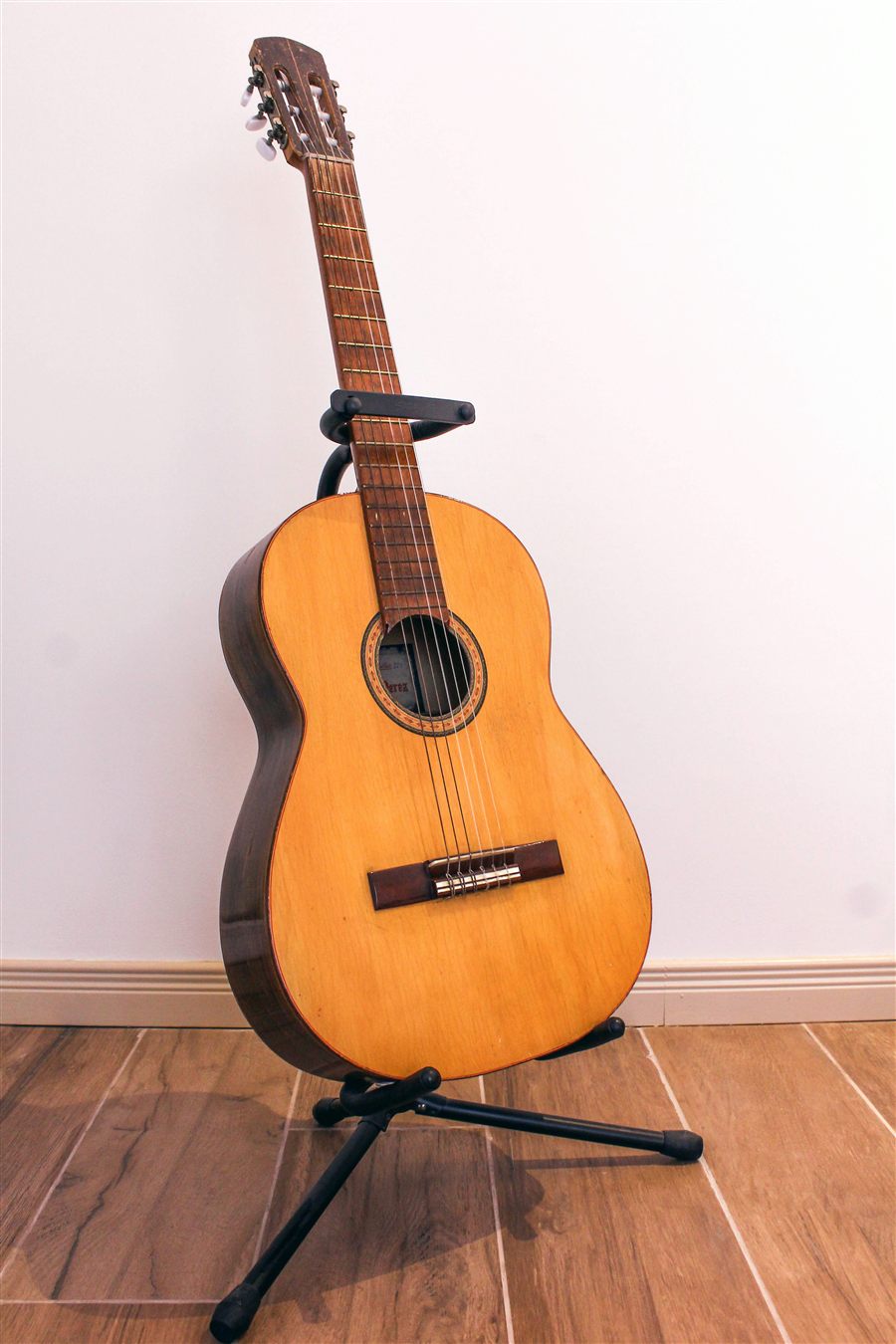
Flamenco and classical guitars are close relatives, but they are built for different goals. A classical guitar aims for a round, projecting tone with long sustain; a flamenco guitar aims for a dry, quick-speaking, percussive sound. To get there it is built lighter and thinner, with a shallower body, lower action and usually a tap plate (golpeador). If you want classical repertoire, buy a classical guitar; if you want to play flamenco, buy a flamenco guitar. A flamenco negra, or a classical guitar with a slightly lower setup, is the usual middle path.
The key differences at a glance
| Feature | Flamenco guitar | Classical guitar |
|---|---|---|
| Sound goal | Attack, speed, percussion | Sustain, warmth, purity of tone |
| Back and sides | Cypress (blanca) or rosewood (negra), sometimes maple | mostly rosewood, mahogany, ovangkol, maple |
| Top | spruce or cedar, thin | cedar or spruce, usually a bit sturdier |
| Body depth | shallower, roughly 90 to 95 mm | deeper, roughly 95 to 100 mm |
| Action at the 12th fret | about 2.5 to 3.2 mm (0.10 to 0.13 in) | about 3 to 4.5 mm (0.12 to 0.18 in) |
| Tap plate | usually present | usually absent |
| Tuners | modern machine heads, traditionally wooden pegs | machine heads |
| Weight | lighter | heavier |
All figures are rule-of-thumb values, because sources and models differ.
Construction in detail
Woods: cypress, rosewood, maple
The traditional flamenco guitar uses light Spanish cypress for the back and sides, a wood with a bright, dry voice. Sycamore (a maple) and walnut are alternatives. Classical guitars lean toward rosewood or mahogany, which add bass warmth and longer ring. Both types use spruce or cedar for the top; for how the two differ in sound, see cedar vs. spruce on a classical guitar. Necks are often cedar or mahogany with an ebony or rosewood fingerboard on both.
Thinner top, lighter bracing
Flamenco guitars are built with thinner walls overall: a thinner top and lighter bracing. That makes the body more responsive, so the note speaks immediately but dies away sooner. How the bracing inside works is covered in fan bracing explained, and why a solid top matters so much is in solid wood vs. plywood.
Shallower body and weight
The sides are usually shallower: about 90 to 95 mm for flamenco against roughly 95 to 100 mm or more for classical. Some sources report differences of several centimetres, so treat the figures as a range. Less air volume means less bass and more directness. Combined with thinner wood it makes a noticeably lighter guitar. A fully solid classical guitar typically weighs under about 3 kg (6.6 lb); there is no reliable figure for flamenco guitars, but they are almost always lighter.
Neck angle and bridge height
Many flamenco guitars have a flatter neck angle and a lower bridge. That allows low action without the strings lying too close to the fretboard.
Tuning pegs
Traditionally, flamenco guitars often use wooden friction pegs of rosewood or ebony. Today machine heads are also common, especially on factory models. Wooden pegs hold by friction, take some practice to tune with, and count as tradition. For a beginner, machine heads are the easier choice.
The tap plate (golpeador)
The golpeador is a thin, usually transparent plastic plate on the top beside and below the soundhole. It protects the finish and wood from fingernails and fingertips during golpes, the percussive taps. A classical guitar normally has none because its repertoire does not call for strikes on the top.
Sound: dry and percussive vs. round and projecting
The flamenco guitar speaks very quickly, sounds bright and crisp, and has a slightly raspy character often compared to a snare drum. Notes decay faster. That is deliberate: in fast rasgueados and accompaniment patterns, chords should not smear into each other. The classical guitar sounds warmer and rounder and carries longer, so melody and bass can ring together. Both are loud in a room. The idea that a flamenco guitar is simply louder does not hold; it is more direct.
Blanca and negra
- Flamenca blanca: cypress back and sides, very short sustain, a bright and dry voice. Suited to accompanying singing and dance and to rhythmic, percussive playing.
- Flamenca negra: rosewood (or another dark wood) back and sides. It has more volume, a wider tonal range and sounds closer to a classical guitar, so it suits solo playing and players who move between styles.
Both keep the lower action and usually the tap plate. The negra is the middle path: you keep part of the flamenco character and gain bass and sustain.
Technique: why the build looks like this
- Rasgueado: chords are fanned out with the fingernails of the strumming hand. It loads the top and wants a guitar that shows rhythmic punch quickly.
- Picado: fast single-note runs with alternating fingers, usually index and middle and often as a rest stroke, where the finger comes to rest on the next string. Low action makes this speed easier.
- Golpe: a strike with a finger or knuckle on the top as percussion; this is what the tap plate is for.
- Alzapua: a pick-like thumb movement, with the thumb striking alternately up and down.
In flamenco the right hand often sits closer to the bridge, which adds to the bright, snappy tone. Anyone learning these techniques seriously should do so with a teacher. For the instrument, the takeaway is simply that the two styles make different demands.
Action: rule-of-thumb values and a self-check
Action is measured at the 12th fret, from the top of the fret to the bottom of the string. A ruler with millimetre or 1/32 inch marks is enough. Typical values (they vary by source):
- Classical guitar: low E about 3.5 to 4.5 mm (0.14 to 0.18 in), high e about 3 to 3.5 mm (0.12 to 0.14 in).
- Flamenco guitar: low E about 3 to 3.2 mm (0.12 to 0.13 in), sometimes down to 2.8 mm, high e about 2.5 to 2.7 mm (0.10 to 0.11 in).
Some players run classical guitars lower, others prefer more clearance; there is no fixed number. What matters is that the guitar is comfortable to fret and does not buzz. Many factory flamenco models are now set up higher so they can also be played in a concert style.
How to check your action
- Tune the guitar properly and let it settle for a few minutes.
- Stand the ruler on edge at the 12th fret and measure to the bottom of the string, first the low E, then the high e.
- Pluck each string lightly. If it buzzes around the frets, the action is too low or the frets are uneven.
- Play through the positions up to the 12th fret. If you have to press hard in the upper positions, the action is too high.
What you can adjust and what you cannot
The most common adjustment is sanding down or replacing the saddle; the nut slots are changed less often. Many classical guitars have no truss rod; on models that do, adjusting it is done in small steps. When you work on a saddle, take material off in small amounts and re-check, because what is removed does not come back. If you are unsure, a repair shop does it; costs vary by shop, get a quote. Fret work or major changes to the neck always belong in a shop.
On buzzing: on a flamenco guitar a light buzz (Spanish "cerdeo") is part of the sound that many players like in flamenco. On a classical guitar it counts as a setup fault.
Which guitar for which player
- You want classical repertoire, études, lessons at a music school: a classical guitar. Technique, scale length and action match the teaching books. For sizing see scale length and neck width for beginners.
- You want to learn flamenco: a real flamenco guitar, ideally a blanca for rhythm and accompaniment, or a negra if you also want to play solo and melodically.
- You want to try both: a negra, or a classical guitar with a slightly lower setup and a retrofitted tap plate.
- You are coming from steel strings: note the differences in string tension and neck width, see nylon vs. steel strings.
Switching: pros and cons
From classical to flamenco guitar
- Pro: very fast response, low pressure at the fingerboard, ideal for rasgueados and picado.
- Con: less sustain and volume, you hear picking mistakes more clearly, and there can be slight buzzing with a hard attack.
From flamenco to classical guitar
- Pro: more tonal fullness, more reserve in volume and dynamics, a more all-round instrument.
- Con: the higher action takes more finger pressure and the response feels slower at first.
In principle you can play anything on either. Basic flamenco technique can be practised on a classical guitar with a tap plate, and classical pieces on a flamenco guitar as long as the action is not too low. Anyone who works seriously in one style will sooner or later want the matching instrument.
Prices and price tiers in the US
Prices are rule-of-thumb values (as of Oct. 2026) and depend heavily on the model.
- Entry level: a quality student flamenco guitar starts at around 400 USD. Below that, playability problems become more likely. Experienced players often describe the jump in quality between roughly 300 and 750 USD as dramatic, with diminishing returns beyond.
- Mid-range: about 600 to 800 USD for a well-regarded student-to-intermediate flamenco guitar.
- Upper tier: around 1,300 USD for an all-solid cypress-and-spruce instrument, and around 2,000 USD for top factory models.
- Handmade: from about 2,500 USD upward.
- Negra with cutaway and pickup: roughly 700 to 750 USD, if you want to plug in.
Prices for classical guitars vary by shop, so compare current listings for the exact model. How factory and hand-built guitars differ is explained in factory vs. handmade guitars. If you are looking at a second-hand instrument, the checklist in buying a used classical guitar applies, plus the condition of the tap plate.
The tap plate: care and retrofitting
- Check its condition: scratches in the plastic are normal. If the edges lift, dirt can get under it; on a used guitar it is worth checking that the top underneath is intact.
- Cleaning: wipe with a soft, dry microfibre cloth, only very sparingly with a lightly damp cloth, never with solvents.
- Retrofitting: self-adhesive transparent tap plates are thin (about 0.011 in, roughly 0.3 mm) and can be cut to shape. Lay one down slowly from one end and smooth out bubbles with a rounded, smooth tool. The adhesive is very strong and removal can damage the finish, so practise on something unimportant or have a shop do it, especially on a valuable guitar with a thin finish.
Removing old adhesive residue with chemicals or warming the finish are jobs for a repair shop, because the finish can easily be damaged.
Myths and misconceptions
- "A flamenco guitar is just a cheap classical guitar": wrong. Good flamenco guitars are demanding instruments built thin and precise for their purpose.
- "A flamenco guitar is always louder": it seems more direct and percussive, not necessarily louder.
- "The only difference is the tap plate": wood, wall thickness, bracing, body depth and setup also differ.
- "Buzzing is always a fault": on a classical guitar yes, in flamenco it can be part of the sound.
- "Blanca and negra are just colours": they stand for the wood and so for the sound: cypress (light) and rosewood (dark).
- "There have always been two guitar types": historically the two were hardly distinguished at first; the clear split came later and is partly cultural.
Common buying mistakes
- Buying a flamenco guitar although you want to practise classical repertoire, then being unhappy with tone and sustain.
- Buying too cheap: very low-priced instruments often have high action, uneven frets and unstable tuners, which is frustrating when learning.
- Choosing by name or wood alone without playing.
- Ignoring the action: it shapes feel and buzzing more than any datasheet detail.
- Sticking on a tap plate with no practice.
Decision help in short
- Which style do you want to play over the next two years? Classical: classical guitar. Flamenco: flamenco guitar.
- Want both? A negra or a classical guitar with medium action.
- Set a budget and plan for at least about 400 USD for a flamenco guitar if you want something durable (as of Oct. 2026).
- Try the guitar in person: action, response, buzz, neck.
- Check the action at the 12th fret and ask whether it can be adjusted.