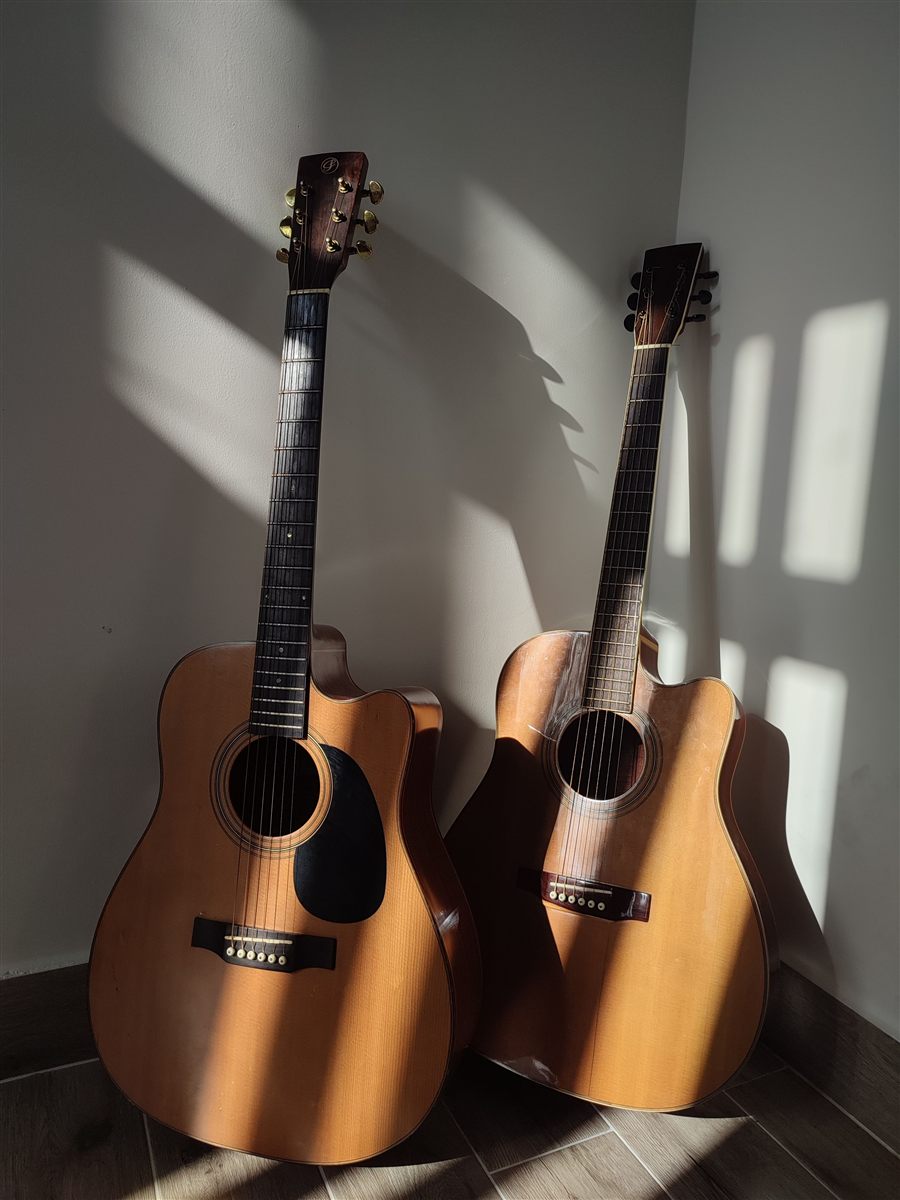
On a steel-string guitar, body shape mostly decides how much bass, volume and sitting comfort you get, not whether the guitar is good. The dreadnought is the powerful all-rounder for strumming and flatpicking, auditorium and grand auditorium shapes are balanced generalists, concert and parlor bodies are smaller, more midrange-focused and more comfortable, and jumbos are big, loud and bass-heavy. If you only buy one guitar, a mid-size shape is usually a safe bet, but what matters most is playing it in your own style.
The main shapes at a glance
From small to large
Most of the names come from C.F. Martin and were adopted or adapted by other makers. From small to large:
- Parlor: the smallest standard shape. The term is loose: it originally meant guitars smaller than Martin's size 0, and today often any guitar narrower than current norms. Expect a focused, midrange-forward voice and often a shorter scale. Parlors were most popular from the late 19th century into the 1950s and have seen a revival since the 2000s.
- Concert (Martin 0) and Grand Concert (00): slightly bigger, descended from classical guitar sizes. Clear and controlled, good for fingerstyle, recording and smaller players.
- Auditorium (000) and Orchestra Model (OM): the smallest shape usually regarded as a full-size guitar. Balanced between bass and treble, workable for strumming and fingerpicking alike.
- Grand Auditorium: wider and deeper than a 000, with a waist between 000 and dreadnought. Taylor introduced the shape in 1994, and it remains Taylor's most popular.
- Dreadnought: the most common shape. Strong bass, lots of volume, a tone that cuts through.
- Jumbo: the largest standard shape, developed by Gibson to rival the dreadnought. Maximum resonant space and a full voice, but bulky.
Decoding manufacturer names
- Martin: the prefix is the size (LX, Junior, 0, 00, 000, OM, 0000/M, GP, SC, J, D), the number after it is the appointment level (15, 16, 18, 28, 35, 40 to 45 and so on), and a suffix like E indicates electronics. A D-28 is a dreadnought at level 28, a 000-18 an auditorium at level 18. "14-Fret" means the neck joins the body at the 14th fret.
- Taylor: groups shapes into small (GS Mini, Baby, Big Baby), mid-size (Grand Auditorium, Super Auditorium, Grand Concert) and large (Grand Pacific, Dreadnought).
- Gibson: the J in J-45 or J-200 refers to the jumbo line, yet the J-45 has a round, sloped-shoulder outline that is closer to a dreadnought. The J-200 began in 1937 as the Super Jumbo and has had its current name since 1955.
Names are not consistent across brands. Martin's "Auditorium" (000) is smaller than Taylor's "Grand Auditorium", and Martin's own "Grand Auditorium" (0000/M) is yet another size. Compare dimensions, not just names.
A short history
Martin built the first dreadnoughts from 1916 for the dealer Oliver Ditson, with round shoulders and twelve frets clear of the body. Under its own name the shape appeared in 1931 as the D-1 and D-2, later D-18 and D-28. At first it was viewed skeptically next to smaller models; sales took off only from the mid-1930s, helped by promotion as a powerful instrument for broadcasting and recording. From the early 1930s the neck joint at the 14th fret also became standard, which improves access to the upper register. Gibson's J-45 followed in 1942.
Dimensions and scale length
The numbers: typical dimensions
Dimensions vary by maker and era, so treat these figures as orientation (conversions rounded, as of Oct. 2026):
| Shape (brand) | Length | Lower bout | Depth | Scale |
|---|---|---|---|---|
| Grand Concert (Taylor) | 19.5 in (about 495 mm) | 15 in (about 381 mm) | 4 3/8 in (about 111 mm) | 24 7/8 in (about 632 mm) |
| Grand Auditorium (Taylor) | 20 in (about 508 mm) | 16 in (about 406 mm) | 4 5/8 in (about 117 mm) | 25.5 in (about 648 mm) |
| Dreadnought (Taylor) | 20 in | 16 in | 4 5/8 in | 25.5 in |
| GS Mini (Taylor) | 17 5/8 in (about 448 mm) | 14 3/8 in (about 365 mm) | 4 7/16 in (about 113 mm) | 23.5 in (about 597 mm) |
| Baby (Taylor) | 15 3/4 in (about 400 mm) | not stated | not stated | 22 3/4 in (about 578 mm) |
At Martin the scales are: dreadnought (D-28) 25.4 in, 000-28, 00-28 and the concert-size 0-18 all 24.9 in, OM-28 and the jumbo J-40 both 25.4 in. Nut width on these models is 1 3/4 in (about 44.5 mm) across the board. Gibson uses a shorter scale on its classics: the J-45 has 24 3/4 in, and the J-200 has a body about 16 7/8 in wide.
Two things stand out. First, Taylor's dreadnought and grand auditorium share length, lower bout and depth; the difference is the waist (11 1/16 in on the Taylor dreadnought versus 9 5/8 in on the Taylor grand auditorium). The dreadnought is much broader in the middle rather than larger at the bottom. Second, Martin's 000-28 and OM-28 use the same body, and only the scale differs (24.9 versus 25.4 in).
Scale length: the hidden second size
Scale length is the vibrating string length. On steel-string guitars it usually runs from 24 to 25.5 in. A longer scale means more string tension at the same pitch and tends toward brighter, clearer overtones; a shorter scale feels softer, sounds warmer and needs less finger force. On the OM-28 the longer scale adds some tension, projection and sustain. That is why a 000 at 24.9 in feels friendlier to many players than a dreadnought at 25.4 in or a grand auditorium at 25.5 in, even though the differences are only a few millimeters. At very short scales you also lose some volume and sustain, which applies especially to parlor and travel guitars.
Neck width
Neck width matters too. Steel-string guitars typically have 43 to 46 mm at the nut, classical guitars up to 52 mm. Many fingerstyle players like slightly wider string spacing, while strummers usually prioritize easy chord shapes.
Tone and playing style: which shape fits what
- Strumming and singer-songwriter: dreadnought or jumbo give the bass and volume to carry a voice. An auditorium shape works too if you prefer clarity over punch.
- Flatpicking and bluegrass: classically the dreadnought, especially for flatpickers who mix strumming and lead work, and for roots music.
- Fingerstyle: parlor, concert, 00 and 000/OM are popular because notes stay well separated and the smaller body eases arm position. They are generally described as focused and midrange-forward. It is not a rule; big guitars get fingerpicked plenty.
- Recording: smaller, controlled shapes (grand concert, 000) are easier to place in a mix; big low end can pile up against other tracks.
- Stage and band: dreadnought and grand auditorium cut through; the grand auditorium suits aggressive strummers and gentle fingerpickers alike.
Dreadnoughts are not automatically boomy and small guitars not automatically thin: woods, bracing and scale shape the sound too. The body shape sets the frame more than the result. For a deeper look, consider shape and tonewood together.
Travel and parlor guitars: the trade-offs
Both are smaller, for different reasons. A parlor is a historic narrow shape with its own midrange-forward character; a travel guitar is built for transport. A distinction is usually made between true travel guitars with full or nearly full scale and children's guitars with reduced scale. Examples: the Martin Backpacker, Taylor's Baby (a three-quarter dreadnought with 22 3/4 in scale) and the GS Mini at 23.5 in, which is sometimes considered a modern parlor.
- Less bass and less overall volume than big shapes.
- A shorter scale means lower tension and easier playing, but slightly less sustain and drive. With a very small body the missing bass becomes audible quickly.
- Some travel models give up parts or use laminate wood to save size and weight, which is common on entry-level models.
- The upside: comfort, low weight, easy to carry; ideal as a couch, travel or songwriting guitar.
A parlor or travel guitar is not a worse dreadnought; it is a different tool. Choose it deliberately, not as a mere stopgap.
Cutaways: what they bring and cost
A cutaway is a scooped section of the body that improves access to the upper frets. The round version is called Venetian, the pointed one Florentine. On acoustics almost only single cutaways are used, since a double one would hurt the sound too much. The benefit goes mainly to players who work beyond the 12th fret. The commonly cited downside is that the body can lose some volume and resonant area. How audible this is, players judge differently; there are no reliable general measurements. Cutaway models also often come with a pickup and target the stage. For pure chord playing at home a cutaway adds little.
Fit: small players, large players, kids
- Small players and kids: most sources online agree that an oversized guitar discourages beginners. Sizes run from 1/8 to 4/4. For small hands the shorter scale matters more than tone. A three-quarter guitar such as the Baby Taylor or a concert-size guitar is worth considering.
- Beginners: it is best to avoid oversized jumbos and 12-strings at first. For beginners, neck comfort and setup count for more than body shape.
- Large players: usually manage dreadnoughts and jumbos well; smaller shapes work too if the arm position is comfortable.
- Sitting position: the dreadnought's wide waist makes it sit slightly higher on the lap, while a concert shape sits more compactly. Only trying it, seated and standing with a strap, settles that.
Buying: used, test-playing and costs
Used market: what to watch regarding shape
When buying used, condition outweighs shape: bridge lift, cracks, bulging behind the bridge and loose bracing are red flags, and a low saddle combined with high action can point to a structural repair such as a neck angle correction, which only a professional workshop should assess and carry out. Beyond that:
- Dreadnoughts offer the widest selection in every price class, which makes comparison and resale easier.
- Smaller shapes such as 000, OM or grand concert are in demand among fingerstyle players, but shape alone says little about price; brand, wood and condition dominate.
- Even identical models sound different, so play a used guitar in person. By experience a discount of around 50 percent off new price is not unusual, and it is wise to budget for a setup (about $60 to $100, as of Oct. 2026).
Test-playing: how to do it right
- Play seated and standing, in your usual position.
- Play in your actual style: fingerpickers pluck, strummers play chords with their usual pick, not just a few quick chords.
- Bring your own pick and capo. Press the low E string down at the 1st fret (capo) and at the 14th fret; in the middle, around the 7th fret, a hair-thin gap should remain (rule of thumb about 0.2 to 0.3 mm, roughly the thickness of a thin business card). Also judge the action at the 12th fret.
- Play each string through all positions and listen for buzzing, dead spots and uneven volume; finally check whether the guitar holds its tuning.
- Compare several shapes back to back, ideally with the same string gauge, or the comparison is skewed.
- Judge the balance between bass and treble, not just volume.
Costs
Shape barely sets the price; brand, woods and build do. As orientation (as of Oct. 2026): at Taylor, entry models start around $449 (Baby) and $499 (GS Mini), the 200 series at $999 and the 300 series at $1,999. The Martin Standard Series (D-28, 000-28, OM-28 and 00-28) costs roughly $3,500 to $3,700 (US list prices), and the Road Series mostly $900 to $2,000. Handmade instruments sit well above that.
Setting up and caring for your guitar: what you can do yourself
Whichever shape you choose, a few simple steps get more playing comfort out of any guitar. Work in small steps and let the guitar settle in between. When in doubt, ask a workshop.
Checking the action
Action is the distance between strings and frets. As a rule of thumb, at the 12th fret it sits at about 2.0 to 2.5 mm on the low E string and about 1.5 to 2.0 mm on the high e string, measured from the top of the fret to the underside of the string. Small bodies with a short scale forgive slightly higher action because the strings feel softer. If the action is clearly higher, playing gets tiring; if it is too low, strings buzz. More on diagnosis in diagnosing string height and neck relief.
Checking intonation
Tune carefully, then compare the harmonic at the 12th fret (touch the string lightly) with the normally fretted note at the 12th fret. If the fretted note is higher, the string is effectively too short; if it is lower, too long. Small deviations are normal on acoustic guitars. If a clear deviation repeats across several strings, look at the saddle, which a workshop can adjust. The basics are in bridge and saddle.
Thinking about string gauge and scale together
Short scales feel softer, long scales firmer. If a guitar feels too stiff, light strings or a set with slightly thinner trebles help; if it feels floppy or buzzes, a slightly heavier set may help. After a change, retune and watch for a few days how neck and action behave. String types goes deeper.
Tuning and tuning stability
New strings stretch at first and drift quickly. After fitting them, gently pull each string lengthwise a little and retune several times until the pitch holds. Always tune up to pitch, so start slightly flat and bring the string up. If a string still will not hold, check that it sits properly on the tuner post and that the machine is not loose.
Transport and storage
Small travel and parlor guitars especially deserve a proper case or gig bag. Keep the guitar away from radiators and windows, and keep humidity in the usual range of 45 to 55 percent. For long storage or shipping you can slacken the strings a little, but do not remove them completely. More in humidity and storage.
Common mistakes and decision aid
Common mistakes
- Buying too big: picking a jumbo for volume and then playing uncomfortably means less practice.
- Buying by name only: a Taylor Grand Auditorium is bigger than a Martin Auditorium.
- Testing in the wrong style: trying fingerstyle on a guitar bought for strumming, or the reverse.
- Ignoring scale length: two guitars of the same shape can differ clearly in tension and feel.
- Overrating the cutaway: it only helps if you really play in the upper positions.
- Dismissing a small guitar as a beginner compromise: for many players a concert or parlor shape is the better long-term choice.
Decision aid
- Strong bass, chord accompaniment, flatpicking: dreadnought.
- One guitar for nearly everything: grand auditorium, 000 or OM.
- Fingerstyle, recording, small frame, couch guitar: grand concert, concert or parlor.
- Maximum volume and bass depth: jumbo.
- Travel: a travel guitar with the fullest scale possible, or a mini shape like the GS Mini.
Related guides
The body shape is only one part of the picture: tonewoods and construction and bracing shape the sound just as much. For string choice see string types, for a very different layout the 12-string guitar, and before you buy, the used-guitar checklist.