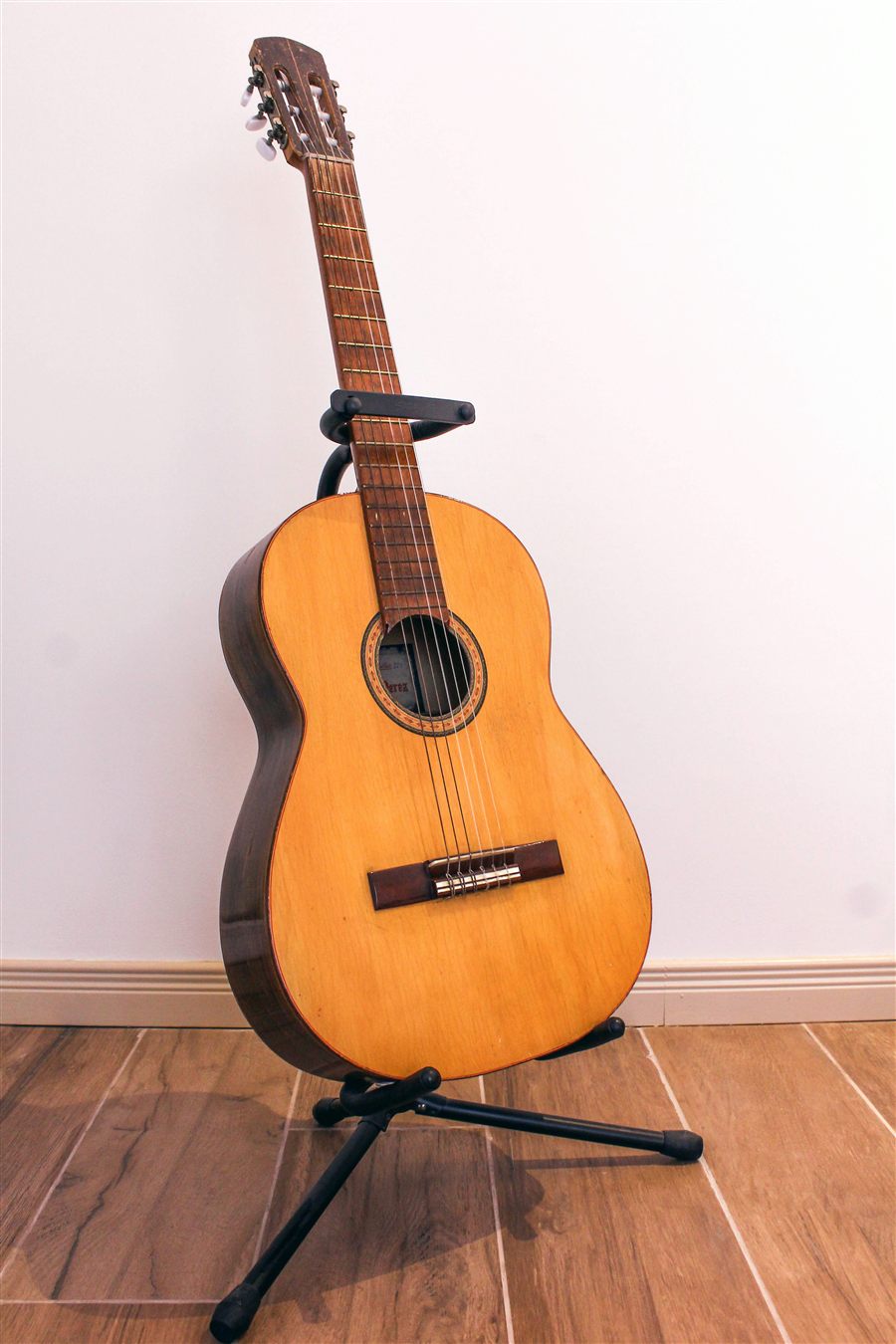
A handmade classical guitar is not automatically better, and a factory guitar is not automatically worse. What matters is a solid top, clean workmanship, a good setup and, above all, the actual instrument in your hands. Price gives only a rough direction: the jump from a student model to a luthier-built guitar is large, but past a certain level every extra dollar buys much less audible improvement.
Factory, workshop and luthier-built: what the terms mean
None of these labels is protected. "Handmade" appears on guitars built in a division-of-labor line and on instruments one builder makes alone from board to finish. It is more useful to sort guitars by how they are made.
- Factory production: Many steps are divided between workers and machines, with fixed dimensions and average solutions for top thickness and bracing. That keeps guitars affordable and consistently available. Typical features are laminated or part-laminated woods, polyurethane finish, simpler tuners and a plastic nut. The spread between individual guitars is wider: two examples of the same model can sound noticeably different.
- Workshop or small-batch builders: Smaller shops with several employees, often with a lot of hand work on the top, bracing, neck fitting and finishing, but with standardized models. A large share of the good mid-range comes from here.
- Luthier-built: One builder makes most of the instrument. They select woods individually, voice the top and bracing to that particular piece of wood and often finish with French polish. Depending on the builder, roughly 180 to 200 working hours go into one guitar.
The boundaries blur. Even expensive "factory" instruments are often largely hand-built, and some individual builders use machines for rough work. The more useful question is how much attention each individual instrument received.
Origin and where guitars are made, stated plainly
Spain has long been the most important production location for classical guitars, from large factories to one-person shops. Master workshops with pure hand work exist in many European countries. Entry-level production models now mostly come from Asia. Mexico has its own guitar-making town, Paracho, whose output ranges from very basic instruments to concert guitars. The country alone says little: very good and weak guitars are made everywhere, and most sources online agree that the individual shop and model tell you more than the location.
Price tiers in the US
These ranges are rough guides for the new US market (as of Oct. 2026). Figures differ by source, especially at the boundaries.
| Tier | Price range | Typical build |
|---|---|---|
| Student | about $300 to $700 | Often a solid top with laminated back and sides, polyurethane finish, simple tuners; fine for beginners |
| Upper factory and workshop | about $700 to $3,000 | Solid woods become common, better tuners and fretwork; spread between models is still wide |
| Luthier-built | from about $3,000, often $5,000 and up | Hand work, selected woods, usually thinner finishes; solid, consistent builders around $3,000 to $6,000 |
| Top luthiers | about $10,000 to $20,000 and above | Reputation drives much of the price (as of Oct. 2026) |
Some very expensive "factory" instruments are largely built by individual craftspeople, so the line is not clean. For waiting times and exact quotes: varies by shop, get a quote.
What the way a guitar is made means for sound and feel
Wood selection and drying
Individual builders pick top and back woods one by one, look for even grain and often season wood for several years. Production runs tend to dry faster and draw from larger batches. A handy rule of thumb: the more evenly spaced the growth rings of the top, the better the wood. For the difference between solid and laminated, see solid vs. laminated wood on classical guitars, and for the effect of the species cedar vs. spruce.
Voicing the top and bracing
A classical guitar top is only about 2 to 3 mm thick and shapes the tone more than any other part. A luthier adjusts thickness and bracing to the individual piece of wood. A factory works with average values that suit some boards better than others. That is why very good production guitars and mediocre one-offs both exist, and why the spread is narrower and on average higher for individually built instruments. For the structural background, read fan bracing explained.
Finish
The finish is one of the biggest differences. Thin shellac (French polish) lets the top vibrate more freely but is more sensitive to scratches, sweat and alcohol, and is touched up rather than replaced when damaged. Polyurethane or polyester finish is thick, tough and cheap to apply, but damps the top more. Reportedly, some workshops spend about half of the build time on finishing, applying several thin coats with sanding and polishing between them, while high-volume lines use one to two weeks and one thick coat. Solid numbers are hard to find; as a tendency, thin and even beats thick and glossy.
How to recognize quality on the instrument
These checks work regardless of the label. Small cosmetic flaws on budget guitars are normal, but on expensive instruments the workmanship should be flawless.
- Fretwork: Run a thumb or fingernail along the fingerboard edges. Fret ends should be rounded and flush, with nothing protruding or sharp. All frets should be the same height and polished smooth.
- Nut and saddle: Bone is durable and self-lubricating, while plastic is cheaper and mostly found in lower tiers. Strings should sit cleanly in their slots without buzzing, and the bridge should sit flat on the top with no gap.
- Finish quality: No runs, drips, bubbles or finish residue at fret ends or in corners. The surface should look even, not wavy or orange-peeled.
- Edges and binding: Edges are cleanly rounded, and binding and purfling sit tight with no gaps or glue residue.
- Tuners: They should turn smoothly and hold pitch. A simple test: tune up, pull the strings firmly upward (without snapping them) and check whether they only slip slightly.
- Interior and glue joints: A small flashlight through the soundhole shows bracing, edge reinforcement and glue lines. Clean, even glue lines with no squeeze-out and no open seams point to care.
- Neck joint and neck: The joint between neck and body is tight with no visible gaps. Sight along the neck from the headstock: it should be straight and not twisted.
- Top wood: Even, fairly straight grain lines and a calm figure point to carefully selected wood. This does not predict tone on its own but is a good sign.
- Symmetry: Do the headstock, rosette, body outline and fret markers look and feel balanced?
Rosette, binding and inlays: what they tell you
Function
The rosette is the decorative ring around the soundhole. Besides looks, it does real work: it protects the crack-prone edge of the soundhole from knocks and humidity swings and adds support there. Binding (the edging of the body outline) protects the edge from knocks and the vulnerable end grain of top and back from moisture. Purfling is the thin decorative strip set slightly in from the edge, which can slow a crack at the rim. These elements have practically no effect on tone.
Mosaic and effort
Classical rosettes are traditionally wood mosaics: thousands of small pieces of maple, ebony, rosewood and other woods are assembled into a pattern of strips or tiles and bordered by purfling lines. A single rosette can take days or weeks depending on the pattern. That is why inexpensive guitars often use printed decals or simple plastic rings, while individual builders often create their own pattern as a signature.
What they reveal about quality and what they do not
- A precisely inlaid, symmetric rosette with tight seams suggests a careful maker. It does not prove that bracing, neck joint and top thickness were done with the same care.
- A crude, uneven or glued-on-looking rosette is a minor warning sign on an unknown guitar, best weighed together with other checks.
- A plain rosette does not mean a lesser instrument. Many excellent guitars keep decoration minimal, and many good instruments have simple binding or none at all.
- Elaborate decoration can simply be part of the price that adds nothing to sound.
Treat the rosette and inlays as a minor secondary hint: useful alongside a playing test and a structural check, never as a replacement for them.
Labels, serial numbers and provenance
On many guitars a label is visible inside the body through the soundhole, often with the workshop name, year and a number. For factory makers the serial number often lets the manufacturer date the instrument, so ask them if in doubt. A label is not proof of authenticity, though, because it can be copied or swapped. For expensive one-off guitars, it pays to confirm the instrument several ways: the seller's written statements about builder, year and condition, the first owner's invoice or certificate, photos of the label and, for large sums, a question to the builder's shop. Always have claims about origin put in writing.
Value retention and resale
Factory instruments lose noticeable value in the first years, like most new goods. For individually built guitars the curve is flatter, and for sought-after builders used guitars can even sell above their original price. In practice, resale value depends heavily on the builder's reputation, less on the quality of the single instrument. Buying a luthier guitar used often saves a large share of the new price and gives you an instrument whose wood has settled over the years and is less likely to crack. Where possible, approach the builder directly, because dealer markups can raise the price noticeably. A percentage loss cannot be stated reliably; get quotes and compare. More on price, condition and inspection is in buying a used classical guitar.
Test-playing checklist
- Bring your own fresh strings or have new ones fitted. Old strings hide quality and differences.
- Look first, play second. Work through the checks above: frets, finish, edges, neck joint, bridge.
- Tune and test tuning stability. After pulling the strings up, the pitch should stay put.
- Check octave intonation. The harmonic at the 12th fret and the fretted note there should agree on a tuner.
- Play every fret and every string. Nothing should buzz or sound dead.
- Listen to the trebles. By experience the upper register is the hardest part for builders to get right. Play demanding high passages and listen for clear, carrying tone rather than thin.
- Balance and volume. Bass and treble should be similarly loud and respond evenly. Play soft and loud.
- Sit in your normal playing position. Comfort, weight and neck profile should suit you. Dimensions are explained in scale length and neck width.
- Do not use someone else's hands as the yardstick. The same guitar sounds different under different hands, so play it yourself.
- Judge against an internal sound ideal. Listen to recordings beforehand and ask whether the guitar approaches the sound you want, rather than just pitting two guitars against each other.
- Clarify returns. For online purchases a full refund without deductions matters more than any price advantage.
Myths and misconceptions
- "Handmade means better": The word is undefined. Factory models also involve a lot of hand work, and weak one-offs exist alongside excellent factory instruments. A luthier guitar is on average better and more consistent, but not in every case better than a good factory model.
- "More expensive means better": Largely true at the low and mid levels, but above that value per dollar drops sharply. Prices of high-end guitars increasingly rest on reputation.
- "The prettiest rosette makes the best guitar": Looks and sound are barely related.
- "A great guitar makes you play great": A guitar does not play for you, but a good one inspires practice and supports progress.
- "Cutaway, fancy color and electronics count": They are extras, not quality, and a cutaway can change the acoustic tone.
- "Spanish is always better than Asian": Not as a blanket rule. Origin says less than model, wood selection and workmanship.
- "Lifting frets are a manufacturing defect": Often the cause is storage that is too dry, not the origin. A steady relative humidity of roughly 40 to 55 percent protects any instrument.
Buying advice by budget and playing level
Complete beginners
A solid factory guitar with a solid top up to about $700 (as of Oct. 2026) is entirely adequate. More important than prestige are the right size, a good setup with low, comfortable string height and an instrument you like picking up. A laminated model can serve for a first try if you are unsure whether you will stick with it.
Intermediate students
The range of roughly $700 to $3,000 (as of Oct. 2026) brings solid woods, a bone nut and better tuners. Play several models in the same price class against each other, because the spread in production is large. A good used workshop guitar is also worth considering here.
Advanced and ambitious players
If you push dynamics, projection and tonal color, including in the trebles, you will appreciate luthier instruments. Try different builders and wood combinations. A used guitar by a respected builder often gives the best balance of price and sound. For new orders, expect a wait; details: varies by shop, get a quote.
One-sentence decision aid
Buy the best instrument you can comfortably afford, test it yourself, and choose by sound and workmanship, not by label.