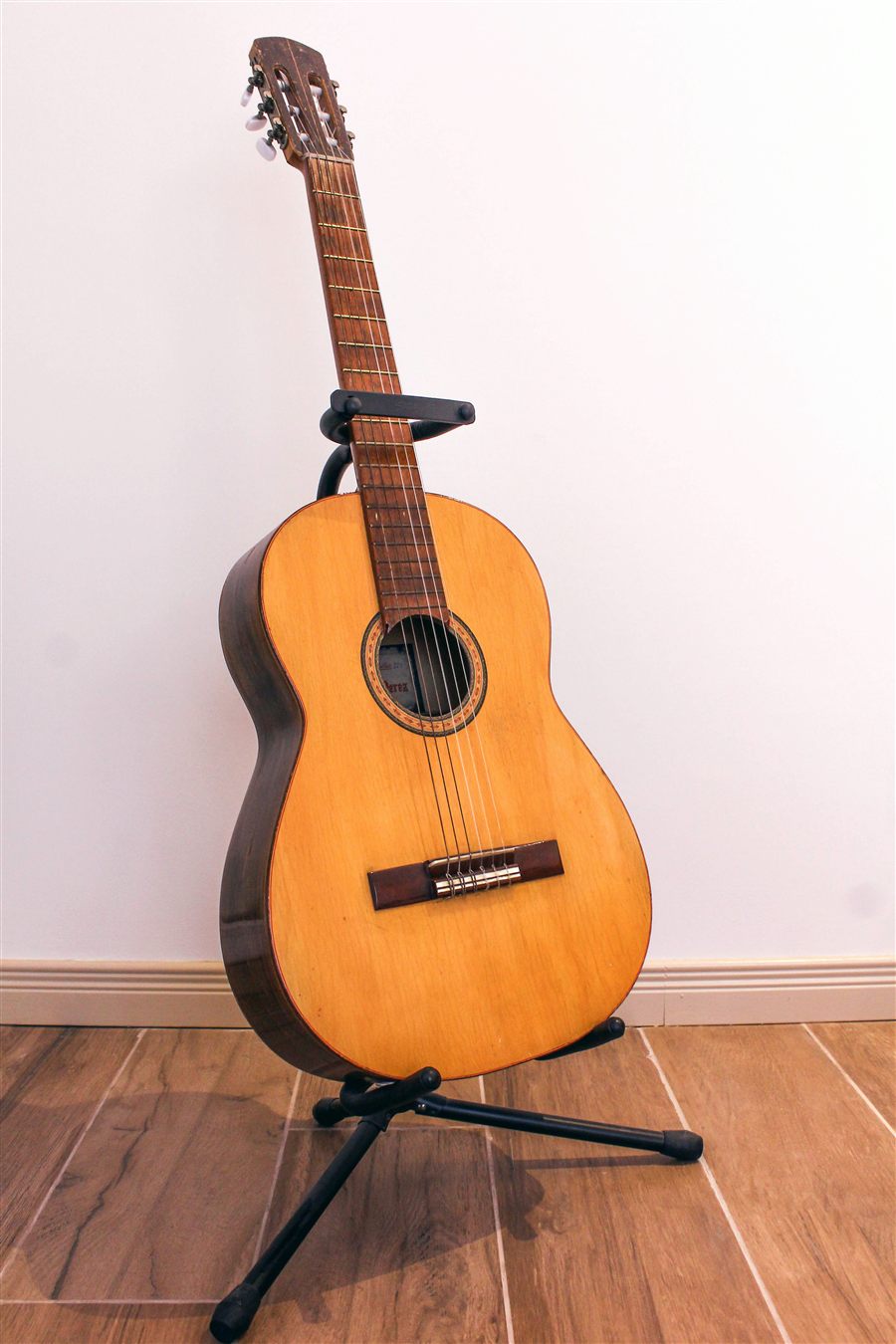
On a classical guitar the top does most of the work. A solid top vibrates more freely and sounds more open, while a laminate (plywood) top is tougher but usually duller. For most beginners, a solid top with laminate back and sides is the best value compromise. All-solid guitars pay off if you can control the climate and want to invest in tone and ageing.
The three construction types
- All laminate: top, back and sides are thin veneer layers glued under pressure. It is cheap, stable through climate swings and typical on student instruments. The top tends to damp more than it vibrates, so the sound is often dull, with few overtones and little dynamic range.
- Solid top (hybrid): the top is one or two book-matched boards of a single species, while back and sides are laminate. Because the top shapes most of the sound, this build gives the biggest tonal gain per dollar. It is the common mid-range recipe and not a red flag.
- All-solid: top, back, sides and usually the neck are solid woods. The tone is the most layered and carries furthest, but the guitar is more sensitive to dry air and costs the most.
Note that "solid" without detail usually describes the top only. Always ask which parts are solid, and get the answer in writing.
Why the top counts so much
A classical guitar top is often only about 2 to 3 mm thick and is the part that turns string energy into sound. A solid board can be thinned and tuned (voiced) very precisely. Laminate is three or more layers with glue between them; it responds more evenly and sluggishly and can hardly be tuned individually. Experienced classical players therefore advise buying a solid top if at all possible, because it will almost always sound better.
Back and sides act as a reflector. Their influence is subtler, but on a classical guitar it is audible in bass depth and overtone richness. If you must save money, save there rather than on the top.
The woods and what they sound like
Top: spruce and cedar
Spruce sounds clear, transparent and focused, with a strong attack and wide dynamic range. Cedar (usually red cedar) sounds warmer and rounder, speaks quickly, but compresses sooner at very high volume. Cedar sounds open when new, while spruce often needs far longer. In blind tests of two guitars from the same builder, one with a cedar top and one with spruce, even experienced listeners cannot always tell them apart: build and the individual instrument often matter more than species. For the details see cedar vs. spruce on classical guitars.
Back and sides
- Rosewood: deep, full bass and ringing, sparkling highs. The standard for upper-tier guitars. Brazilian rosewood is the benchmark but is practically unobtainable as new material and drives up prices sharply.
- Mahogany: warm and balanced with softer highs. Common on beginner and mid-range models. Next to rosewood it sounds somewhat thinner and more direct.
- Maple: bright, tight and clear with less bass warmth. Less common, but a proven choice for transparent sound.
- Cypress: the traditional wood of the white flamenco guitar, light with a quick, bright voice. It is also possible on classical guitars. More in flamenco vs. classical guitar.
- Substitutes: because rosewood is scarce and regulated, builders increasingly use other tropical and temperate woods such as ovangkol, cherry, walnut, or katalox, jatoba, pau ferro and granadillo. They can be convincing, but sound varies from wood to wood. If in doubt, listen instead of trusting the name.
Neck and fingerboard
Necks are usually mahogany (often African), cedar or maple: workable enough to shape and stable against string pull. Fingerboards are usually ebony or rosewood; ebony is very hard and wears slowly. On very cheap instruments the fingerboard often feels uneven or rough, a sign of basic workmanship. Composite materials occasionally appear on fingerboards. A warped neck is a common fault on bargain models; for neck shape see scale length and neck width.
Price tiers in the US
Figures vary by source, so treat them as rough guides (as of Oct. 2026):
| Price range | What to expect |
|---|---|
| under ca. 100 USD | Poor quality; tuning and intonation problems are common |
| ca. 300 to 700 USD | Factory-made, acceptable entry level; construction varies from laminate to solid top |
| ca. 300 to 1,000 USD | Range often recommended for beginners; check whether the top is solid |
| ca. 3,000 USD and up | Handbuilt by a luthier, premium materials, custom options |
Within the middle of the market, models with a solid top and laminate rosewood back and sides appear at around 1,000 USD (as of Oct. 2026), while all-solid guitars from Spanish workshops are often priced several hundred dollars higher. Whether the all-solid build is worth the difference depends on your climate and how much you value ageing and resonance. For more on build quality see factory vs. handmade guitars.
How to recognise solid wood
- Read the spec sheet: terms such as solid, all-solid, laminate and veneer usually appear in the description. If they are missing, ask.
- Look at the soundhole edge: shine a flashlight on the cut edge of the top at the soundhole. Solid wood shows one consistent grain through the thickness; plywood shows layered stripes.
- Check the grain: the two halves of a solid top are usually mirrored (book-matched) but never perfectly identical. A suspiciously perfect repeat points to veneer or a printed layer.
- Look at the inside: through the soundhole, the inner surface of back and sides on a laminate looks different from the outside, often rougher or uniform.
- Tap it: tap the top lightly with a knuckle. Solid sounds lively and rings longer, laminate rather short and dry. This is a hint, not proof.
Limit: an edge can be finished or hidden, and veneer can look convincing. When in doubt, rely on the spec sheet or a written statement from the seller.
Durability and climate
Solid wood moves with humidity: it swells when damp and shrinks when dry. Laminate is much more stable thanks to its cross-glued layers. The first sign of air that is too dry is sharp, protruding fret ends, then cracks in the top or back. Air that is too damp dulls the sound and can stress glue joints.
- The common target is 45 to 55 percent relative humidity at room temperature (as a guide). Some sources give 40 to 60 percent. Below about 30 percent, a top is likely to distort and eventually crack.
- Measure with a reliable digital hygrometer; cheap dial gauges are often inaccurate.
- In winter a case humidifier helps; in a humid summer, a desiccant.
- After temperature changes, let the guitar acclimate in its closed case for about an hour.
- Keep it away from radiators, windowsills, direct sun and cars (temperatures between roughly 60 and 85 F are comfortable).
Hairline cracks can appear in some woods, such as cedar and Brazilian rosewood, even without care mistakes, since wood is a natural material. If you see a crack, stop playing hard and take the guitar to a qualified repair shop; whether and how it needs gluing is a job for a professional. Cost depends on the extent: varies by shop, get a quote.
Finish: gloss, matte, French polish
The finish protects the wood and affects the sound, mainly through its thickness.
- French polish (shellac): a very thin, hand-applied finish that lets the wood vibrate most freely. It needs roughly three to four months to cure fully, is sensitive to sweat and heat, and can be re-polished at any time. Usual on high-end and handbuilt guitars.
- Polyurethane (gloss or satin): thick, tough and easy to maintain, standard on production models. The thicker the coat, the more it can restrict vibration. A thin, well-cured spray coat does better than a heavy lacquer shell.
- Nitrocellulose lacquer: thinner than polyurethane, sometimes used on the top only. It does not tolerate solvents such as alcohol.
- Matte: usually a thinner coat that feels pleasantly smooth, but more delicate; rubbing too hard gradually makes matte areas shiny.
Opinions differ on gloss: some say a thick glossy layer sounds warmer, others say it deadens the top. Treat it as a tendency. Application matters more: lacquer sprayed without enough drying time can hamper resonance. Handbuilding shops often finish in several thin coats over weeks, while factory production is much faster. That is a quality marker, not proof of tone.
Care: use a soft cloth, slightly damp for dirt; no solvents, no alcohol on nitro or shellac, no harsh polishes.
Playing in and ageing
A new classical guitar with a solid top changes with time. As a rule of thumb, expect about a year of intensive playing during which ageing and curing affect sustain and treble. Spruce can take longer to mature, with figures running up to several years of regular playing. Cedar sounds more open from the start. How large the effect is remains hard to measure and mostly anecdotal.
Laminate does not gain in the same way. Experienced buyers like used instruments because the wood has settled, lowering the risk of cracks and neck problems. After the first months it is often worth re-checking the string action, as neck and top settle under string tension. See buying a used classical guitar for more.
Rosewood and species protection, in general
Brazilian rosewood has been under strict trade protection for decades; other rosewood species have been under trade controls since 2017, and finished instruments now enjoy exemptions that depend on the species. For you this means: within the US it is rarely an issue, but travel, purchases abroad or cross-border sales may require paperwork. Ask the competent authority, and have the seller confirm the wood in writing. This is not legal advice.
Common bad buys and myths
- "Solid" taken at face value: often only the top is solid and the rest is plywood. That is fine if the price matches.
- Too cheap: very cheap guitars often come with tuning problems, warped necks, rough frets and a muffled tone from thick lacquer. The money is then lost, not saved.
- Buying by wood name: rosewood on the label does not guarantee good sound; the top, the build and the individual instrument decide. Try several guitars in the same price tier.
- "Laminate is junk": not automatically. It is stable and sensible for beginners, travel and dry or changeable rooms, but sounds plainer.
- "Expensive means better": price also reflects scarcity, looks and labour. Sound decides.
- Ignoring climate: the most common cause of damage to solid wood is dry heated air in winter. A hygrometer costs little.
With factory instruments in particular, not every solid-top guitar is carefully built; frets, glue joints and bracing on budget models are sometimes finished less thoroughly. Always judge workmanship and feel as well.
Decision guide
- First guitar, small budget, changeable room climate: a solid top in the 300 to 1,000 USD band (as of Oct. 2026), or laminate if needed, but not the cheapest.
- Ambitious player, stable climate: solid top plus rosewood or an equivalent wood, or all-solid if the budget allows.
- Concert, recording, long-term investment: handbuilt, French polish, with time to test-play; used guitars from good hands are an option.
- For comparing: same strings, same volume, several guitars in a row; see also nylon vs. steel strings and fan bracing explained.